
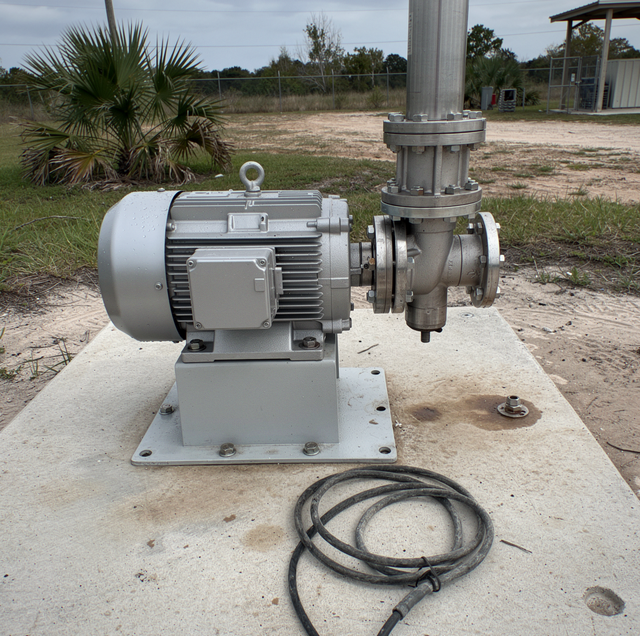
When a turbine pump starts to vibrate harder than it used to, the cause can sit anywhere in a chain of parts: a motor at the surface turns a long lineshaft that runs down through a column pipe to a bowl assembly and its stack of impellers, submerged deep in the well. Because that shaft is rigid and spins the whole time the pump runs, wear or misalignment anywhere along its length travels the length of the column and can show up as a shake or a knock at the motor head. A new vibration means something changed in the pump, its base, its power, or the water level it runs in, and not necessarily at the point where you feel it.
Each vibration pattern pairs with the part of the pump to look at first:
| Pattern | Where to Look |
|---|---|
| Shakes at every start, even once the column is full | The coupling and motor mounting at the head |
| Steady vibration coming from the motor itself | The motor's own bearings, checked by running it uncoupled |
| Grows the longer the pump runs on a single set | Water level and submergence over the bowls |
| Arrives together with sand in the discharge | The bowls and impellers |
| A rhythmic knock, once per shaft turn | A bent shaft section or a worn lineshaft bearing |
| Started right after the pump was pulled or serviced | Shaft adjustment and coupling reassembly |
| The base or pad has visibly shifted | The foundation under the discharge head |
The Motor and Coupling at the Head
The coupling is the single connection between the motor shaft and the pump's own shaft. Starting torque loads a coupling harder than steady running does, so hardware that has worked loose can show as a jolt at each start as well as a shake while the pump runs. Motor mounting bolts can do something similar: a base that has loosened lets the whole motor rock slightly with each start, and that motion reads as vibration even though nothing below the head has changed. Coupling alignment and mounting hardware are checked at the head first, since both can be reached without pulling the pump.
A turbine motor operates at high voltage at the wellhead, and a rotating shaft or coupling can catch clothing or a hand. A well technician locks off the power at the disconnect before any checks near the head.
The Lineshaft and Its Bearings Down the Column
Below the coupling, the lineshaft runs the length of the column, held straight at intervals by bearings seated in retainers, spaced closely enough that no unsupported span reaches the speed at which it would start to whip on its own. An open lineshaft design runs those bearings in the well water itself; an enclosed design runs them inside an oil-filled tube separate from the water. Either way, as a bearing wears, the shaft gets a little more play at that support point, and a shaft that is not running dead straight begins to flex slightly with every rotation instead of turning true. A bearing worn loose stops supporting the shaft at that point, so the unsupported span on either side of it lengthens. A knock that repeats once per shaft turn, rather than at random, can trace to a worn bearing or a section of shaft that has gone slightly out of straight.
The Bowls and Impellers: Sand Wear and Cavitation Near the Intake
The bowl assembly is the pump itself: a stack of bowls, each housing an impeller, submerged low enough in the well that a strainer or suction bell covers the intake. Sand or grit passing through wears the bushings inside each bowl, and the impeller surfaces themselves, and as that wear opens the clearances that once held the shaft centered, the shaft has room to wander slightly off-center with every rotation. That wander is what shows up at the head as vibration, and it arrives alongside sandier water rather than in place of it, since the same grit doing the wearing is also passing through. Cavitation is a separate mechanism from wear: if the water covering the bowl intake runs thin, or the pump is asked to draw harder than the well can supply, pockets of vapor form, then collapse against the impeller's own surfaces. Over time, that collapse pits and erodes the metal it strikes, roughening surfaces that once ran smooth. The collapsing vapor shakes the pump erratically and carries a crackling noise, a pattern distinct from the steady rhythm of bearing wear.
Water Level and Drawdown
A turbine set to run for hours at a stretch, the kind of long set irrigation and agricultural use can call for, pulls the water level down inside the well over the course of that run. The bowls were set deep enough to stay covered at the pumping level the well was expected to reach, and the farther the level falls below that during a run, the less water covers the intake. A vibration that starts smooth and grows rougher the longer a set continues, with no change in the water itself, fits falling submergence over the bowls, and it is worth noting how far into a run the shake begins. A vibration that once appeared only late in a long run and now starts earlier in the same run can mean the well now draws down farther than it did, from a lower resting level or from a well that yields less water than it once did.
The Base Plate and Foundation
The discharge head sits bolted to a sole plate, and that plate sits on a foundation, either a concrete pad or the top of the well casing itself. Anchor bolts hold the sole plate to that foundation, and a bolt working loose lets that side of the plate move under the starting torque. If that base has settled, cracked, or shifted even slightly, the column above the bowls no longer hangs plumb, and a shaft that was running straight starts to rub or flex unevenly at every bearing point along its length. This kind of vibration is present from the moment the pump starts and does not build or settle. A look at the base shows why: whether it is a gap between the plate and the pad, a crack running from a bolt, or the whole assembly sitting off level.
What a Pump Service Visit Checks and Compares
A service visit for a vibrating turbine works through the chain from the head down: coupling tightness and alignment, motor mounting, bearing play at the head and shaft runout at the coupling, water level readings taken at rest and again under load, and a look at the base and foundation for movement.
A shaft-adjusting nut at the top of a turbine pump sets how closely the impellers sit in the bowls; if set wrong or slipped after service, it lets the impellers drag on the bowl seats and shake the head.
A technician also compares what the pump produces with what it was built to deliver. After a pump is pulled and reset, a coupling not drawn up fully can bring back the vibration the service was meant to cure.
Frequently Asked Questions
Yes. When a turbine stops, water in the column drains back through the bowls and can spin the shaft backward, and starting the motor during that backspin shocks the shaft and couplings. Some motors carry a non-reverse ratchet that holds the shaft against backspin.
It can. The motor and discharge head, standing on the base, have a natural frequency of their own, and when the pump's running speed is near it, a small imbalance that would otherwise go unnoticed can set the head shaking. That kind of vibration is treated at the mounting, by stiffening it or changing its mass, or by moving the running speed away from that frequency.
Yes. A three-phase motor missing one leg of its power supply, a condition sometimes called single-phasing, will keep turning but run hot with a heavier hum and a vibration at the head that has nothing to do with the shaft, the bearings, or the bowls. The motor can keep running in that state for a while before it trips or fails outright.
A brief shake while the column fills and air is pushed out at the head can come with a start and settle once water reaches the discharge. A shake that continues after the column is full, or returns on every start, is a different matter.
Vibration can be the earlier warning of the two. Bearing and impeller wear inside the bowls can progress for a while before it reduces clearance enough to measurably change output, so a pump that is still delivering its normal flow at the tap or in the field can already be vibrating enough to warrant attention.
Yes. Vibration carries well along a rigid shaft and column, so a problem seated at the motor's own bearings or its coupling can be felt or heard as though it starts lower down, closer to the bowls. Briefly running the motor, uncoupled from the pump shaft, is one way a technician can determine whether the motor itself is the source before looking any further down the column.
Bring in well pump service for a vibrating turbine — a check of the coupling and shaft at the head, the bowls below, and the base under the discharge head. Fussell Well Drilling serves Polk County and Central Florida. Call (863) 984-3144.