
Why Your Well Water Is Staining Sinks and Toilets Orange
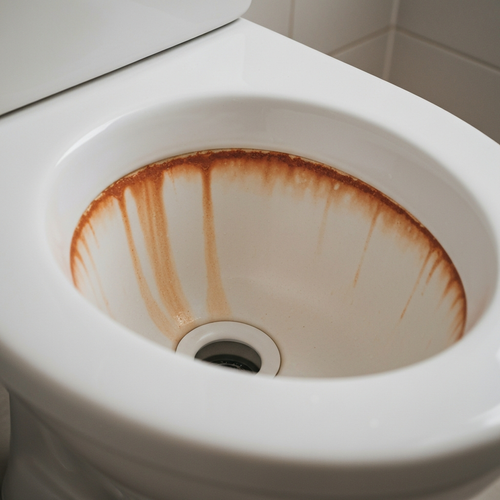
Quick Answer: Orange or rust-colored staining from well water is almost always iron. Dissolved iron in the water oxidizes when it hits air and surfaces, leaving the rusty stains on sinks, tubs, and toilets. Related culprits are iron bacteria (which leave a slimy orange or reddish buildup) and manganese (darker brown-black stains). The staining is a water-quality issue, not damage to your plumbing. A water test identifies which problem you have, and treatment — oxidation and filtration or a softener — removes the cause.
If your well water is leaving rusty orange streaks in the toilet bowl, stains in the sink, and a tint on the laundry, the well is telling you it's carrying iron. It's one of the most common well water complaints, and while the stains are a nuisance, they're a water-quality issue you can treat — not a sign your pipes are rusting away. Knowing exactly which form of iron (or related mineral) you have is the key to picking the right fix, and that starts with a test.
Why Iron Stains Everything Orange
Groundwater often picks up iron as it moves through soil and rock, and well water commonly carries it dissolved and invisible. The moment that water meets air — or an oxidizer — the dissolved iron oxidizes, turning into the reddish-brown rust particles you can see. Those particles settle onto whatever the water touches: the toilet bowl, the sink, the tub, fixtures, even laundry. That's why the water can look clear from the tap and still leave orange stains as it sits and dries. It's the same chemistry that rusts metal, happening on your bathroom surfaces.
The amount of staining tracks with how much iron is in the water, which is why some wells leave faint tints, and others leave heavy rust marks that come back days after cleaning.
Iron Isn't the Only Possibility
While dissolved iron is the most common cause, two related culprits look similar and need mentioning, because they change the treatment:
- Iron bacteria — harmless bacteria that feed on iron and leave a slimy, reddish-orange or brown buildup in toilet tanks, fixtures, and the well itself. The telltale sign is a slimy texture rather than just a stain, sometimes with an odor. Iron bacteria often need a disinfection step in addition to filtration.
- Manganese — another mineral that comes up in well water and leaves darker brownish-black or even purplish stains rather than orange. It frequently appears alongside iron and is treated similarly, but it's worth identifying.
This is exactly why a water test matters: orange staining indicates iron is involved, but whether it's dissolved iron, iron bacteria, manganese, or a combination determines which treatment actually solves it.
| What you see | Likely cause | Notes |
|---|---|---|
| Rusty orange stains, clear water that discolors as it sits | Dissolved iron | Most common; oxidize and filter |
| Slimy orange/red buildup, possible odor | Iron bacteria | Needs disinfection plus filtration |
| Dark brown-black or purplish stains | Manganese | Often with iron; treated similarly |
| Staining plus rotten-egg smell | Iron with sulfur/bacteria | Test to confirm the mix |
How It's Treated
Because the staining comes from iron in the water, the fix is treating the water before it reaches your fixtures — and the right system depends on the type and amount of iron, which the test reveals. Common approaches include an iron filter that oxidizes the dissolved iron and filters out the resulting particles, and for lower levels combined with hardness, a water softener can remove some iron along with the calcium and magnesium. Higher iron levels, or iron bacteria, usually call for a dedicated oxidizing filtration system, and iron bacteria specifically need disinfection (such as shock chlorination of the well) to knock back the bacteria, often paired with ongoing treatment.
The wrong system won't solve it — a softener sized for hardness may not handle heavy iron, and filtration alone won't clear up iron bacteria without disinfection. That's why the sequence is test first, then match the treatment to what's actually in the water. Once the right system is in place and maintained, the staining stops because the iron is removed before it ever reaches your sinks and toilets.
Maintenance is part of the deal, too. Iron treatment systems need periodic upkeep — backwashing, media replacement, or recharging, depending on the type — to keep removing iron at full strength. A system that's neglected gradually lets iron slip through again, and the orange stains creep back, which can make people think the treatment failed when it really just needed servicing. Building that upkeep into your routine, the way you would any well-system maintenance, is what keeps the water clean and the fixtures stain-free over the long haul. Because well water can also change over time, an occasional re-test is worthwhile to confirm the system is still matched to what the well is producing.
Frequently Asked Questions
Because it contains iron. Well water often carries dissolved, invisible iron, and when it hits air and surfaces, the iron oxidizes into rust-colored particles that stain sinks, tubs, toilets, and laundry. The water can look clear from the tap and still leave orange stains as it dries. The more iron in the water, the heavier the staining. A water test confirms the iron level and type.
Iron in water is primarily an aesthetic and nuisance issue rather than a plumbing failure, but staining water should be tested to identify exactly what's in it — dissolved iron, iron bacteria, manganese, or a combination — and to rule out related concerns. Testing is the right first step, both to confirm what's causing the stains and to choose a treatment. A water professional can interpret the results and recommend a system.
Dissolved iron leaves rusty orange stains as it oxidizes, and the water is typically clear until it sits. Iron bacteria are organisms that feed on iron and leave a slimy reddish-orange or brown buildup in toilet tanks and fixtures, often with an odor — the slimy texture is the giveaway. The distinction matters because iron bacteria require a disinfection step, whereas dissolved iron is handled by oxidation filtration.
Sometimes, for lower iron levels combined with hardness, a softener can remove some iron along with calcium and magnesium. But heavier iron usually needs a dedicated iron filter that oxidizes and filters it out, and iron bacteria need disinfection that a softener doesn't provide. That's why testing first matters: it tells you if a softener is enough or if you need dedicated iron treatment.
Treat the water before it reaches your fixtures. Start with a water test to identify the type and amount of iron, then install the matching system — an iron filter for dissolved iron, disinfection plus filtration for iron bacteria, or a softener for lower hardness levels. Once the iron is removed at the source and the system is maintained, the staining stops returning.
Test First, Then Treat the Source
Orange staining is your well water carrying iron, and the rust marks are that iron oxidizing on your fixtures. It's a treatable water-quality issue, not failing pipes — but the right fix depends on which form you have — dissolved iron, iron bacteria, or manganese. A water test answers that, and the matching treatment removes the iron before it ever reaches a sink or toilet. Solve it at the source, and the stains stop coming back.
Tired of scrubbing orange stains from your well water? — Get your water tested and the right iron treatment matched to it. Fussell Well Drilling serves Polk County and Central Florida. Call (863) 984-3144.
