
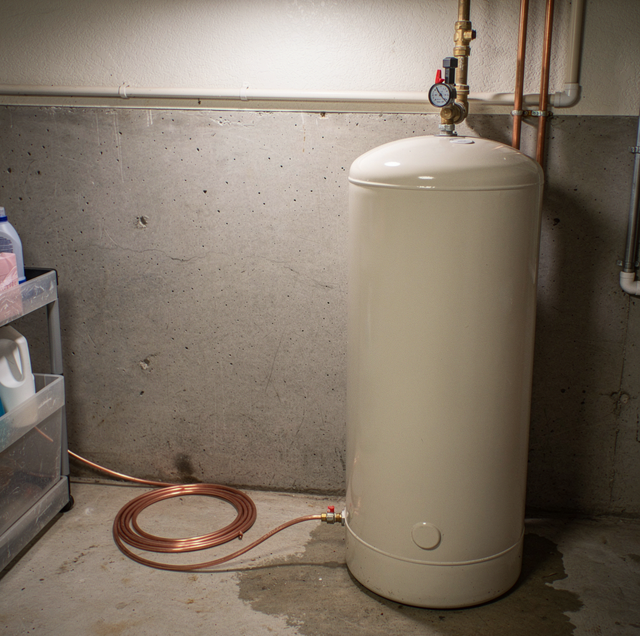
A well's pressure tank does the same job no matter which one sits beside your pump: it holds a pocket of compressed air that pushes stored water out to the house between pump cycles. Two very different tank designs get built to do that job. The difference between them comes down to whether the air pocket stays sealed away from the water it's pressurizing, or whether the two share the same open space inside the tank. That one design choice drives the rest: the upkeep each tank requires, the floor space it occupies, and how it eventually fails. Set side by side on air-water contact, waterlogging, upkeep, space, and the part that fails, the two designs split this way:
| Bladder / Diaphragm Tank | Conventional (Air-Over-Water) Tank | |
|---|---|---|
| Air-water contact | Sealed apart by a rubber barrier | Air sits directly on the water, with no barrier |
| Waterlogging | Does not happen while the barrier is intact | Develops over time, since exposed air steadily dissolves into the water it touches |
| Upkeep | A precharge check at the air valve | Periodic air recharging, by hand or through added equipment |
| Space | Compact; fits a small vertical footprint | Needs a larger shell for a useful air reserve, and can be mounted horizontally |
| What fails | The rubber barrier tears, or the air valve leaks slowly | The steel shell corrodes internally, or the recharge hardware fails |
How Each Tank Holds Its Air Charge
A pressure tank's whole purpose is to store a compressed-air cushion so the pump can rest between draws instead of starting for every single tap. How that air is kept in place is where the two tank families split. A bladder or diaphragm tank builds a rubber barrier into the shell at the factory, so the air charge lives on one side of that barrier, and the water sits on the other, and the two never touch. A conventional tank skips the barrier entirely. It's a single open steel shell in which a pocket of compressed air rides atop a body of water, with nothing separating them but gravity and pressure.
That open design is the simpler and older of the two approaches, and it served well water systems for decades before rubber barriers became standard. The tradeoff shows up over time rather than on day one: exposed air and exposed water start exchanging with each other the moment they're in contact.
Why Conventional Tanks Waterlog and Need Recharging
Air in direct contact with water does not stay put. A little of it dissolves into the water with every fill cycle, since exposed air in contact with the liquid steadily works its way into the water. In a bladder tank, that never happens, because the barrier keeps the air on its own side no matter how many times the tank fills and empties. In a conventional tank, every cycle bleeds off a small amount of the air charge, and there is no seal to stop it.
Left unaddressed, that steady loss shrinks the air pocket until the tank holds water where its air cushion used to be, the condition known as waterlogging. A waterlogged tank of either type ends in the same short-cycling failure pattern that wears out a pump fast, which is its own separate problem. Because a conventional tank loses air by design, that air has to be put back somehow, whether by a technician recharging it by hand or through added equipment some systems use to keep it topped off. A bladder tank, by contrast, only loses pressure when its air valve leaks or the barrier itself fails, since none of its air ever touches the water.
Where a Conventional Tank Still Fits
None of this makes a conventional tank obsolete. Where a system needs a lot of stored volume, a system serving several buildings from one well, for example, a single large conventional tank is a practical build, since matching that same volume with bladder tanks can take multiple smaller units and more floor space. No rubber barrier eventually wears out from years of flexing, which matters in a system that cycles hard.
The trade-off a property owner takes on with a conventional tank is ongoing air management rather than a sealed barrier that requires only a precharge check. On a system that already has reliable air-recharge equipment in place and has held steady, replacing a failed tank with another conventional unit can be the simpler path, especially where the larger footprint isn't a constraint. It comes down to matching the replacement to the existing setup, rather than treating one design as universally better than the other.
What Fails on a Bladder Tank
A bladder or diaphragm tank trades the air-loss problem for a different one: the barrier itself is a wear part. Rubber that flexes every time the tank fills and empties eventually fatigues, and a wrong air charge that overstretches it, or a freeze, can split it as well. A bladder can also develop a tear or a slow leak where it's clamped inside the shell. Once that barrier fails, air and water mix just as they would in a conventional tank, and the tank behaves as if it had no separation at all.
The two designs differ in how much of that fix a technician can do on-site. A diaphragm-style tank bonds or welds its membrane to the shell at the factory, so a torn diaphragm means the entire tank must be replaced. Some bladder-style tanks hold their liner in place with a compression flange near the base instead, and where that flange is built in, a technician can pull the old bladder and fit a new one without replacing the shell, as long as the shell itself hasn't corroded or cracked.
A pressure tank stays pressurized after the pump stops, and a fitting or air valve opened under that pressure can blow water and parts outward; tank work starts with the pump's breaker off and is the well technician's responsibility.
How the Choice Gets Made on a Replacement
When an existing tank fails, and it's time to put in a new one, the decision starts with how the old tank behaved rather than a blanket preference for one design. A system that repeatedly needs its air recharged, or that waterlogs despite recharging, can point to a bladder or diaphragm replacement once a failed air-charging part or a leak at the tank's fittings has been ruled out. A system that has run for years on a conventional tank without much trouble, especially one already fitted with working air-recharge equipment, doesn't necessarily need to change designs just because the tank itself wore out.
Available space plays into it too. A bladder tank's compact, vertical footprint fits into a tight well house or utility closet more easily than a large conventional shell does, which can settle the choice on its own in a cramped space.
Frequently Asked Questions
The pump and switch can stay, but the air-charging parts do not: a conversion from a conventional tank to a bladder tank removes or plugs any air volume control, snifter valve, or bleed orifice that fed air to the old tank, since air pushed into the new system collects in the pipes and spits at the taps. The new tank's air charge is also set against the switch's existing cut-in setting by the technician.
Some older galvanized tanks carry a floating disc, or wafer, that rides on the water surface and shrinks the area where air meets water. It slows the air loss without sealing it off, so a tank with a wafer still needs its air charge restored over time.
Some conventional systems use an air volume control that admits air to the tank when the water level inside rises too high; on a jet-pump system, it draws that air through the pump's suction side. Where no such part is fitted, a technician restores the air charge either by draining the tank so that air refills it or by using a compressor at the air valve.
Yes. A second tank of either type can be piggybacked onto the same line to increase drawdown without replacing the original. Adding a bladder tank to a system anchored by an older conventional tank is a way to increase capacity for a growing household or increased water use without swapping out the tank already in place.
A conventional tank is steel throughout, galvanized or lined, because the water sits directly against the shell. A bladder tank holds water inside the bladder rather than against the steel, and some are built with a composite shell that does not rust.
Both do. Every pressure tank, bladder or conventional, carries a maximum working-pressure rating stamped on its data plate, and the switch's cut-out has to stay below that stamped rating on either design. That limit applies the same way to both tank families; the design difference between them doesn't affect how much pressure the shell itself can withstand.
Set up a pressure tank replacement — a bladder or conventional tank matched to your pump, switch settings and available space, with any old air-charging parts removed where a bladder tank goes in. Fussell Well Drilling serves Polk County and Central Florida. Call (863) 984-3144.