
The water ran clear on Tuesday. Rain fell hard through Wednesday night. By Thursday morning, your kitchen tap was pouring brown water, the toilet tank was refilled with brown water, and you had stopped the laundry mid-cycle.
That sequence is the answer. Water that turns brown during a storm was lying on the ground a few hours earlier, and it carries what the ground carries. Cloudy water a well produces on its own is a nuisance; cloudy water that arrives with the rain is a breach. Where that breach sits determines whether a repair at the cap or opening the ground around your casing is needed. The path from the surface to your water column runs through the cap, down the outside of the casing, and into the formation, and every stretch of it can leak.
A Failed Cap Sends Runoff Straight Down the Casing
Sediment a well has produced since the day it was drilled is a standing condition, with causes down in the borehole that behave the same in a dry month as in a wet one. This is the other kind: on the ground Wednesday, in the casing Thursday.
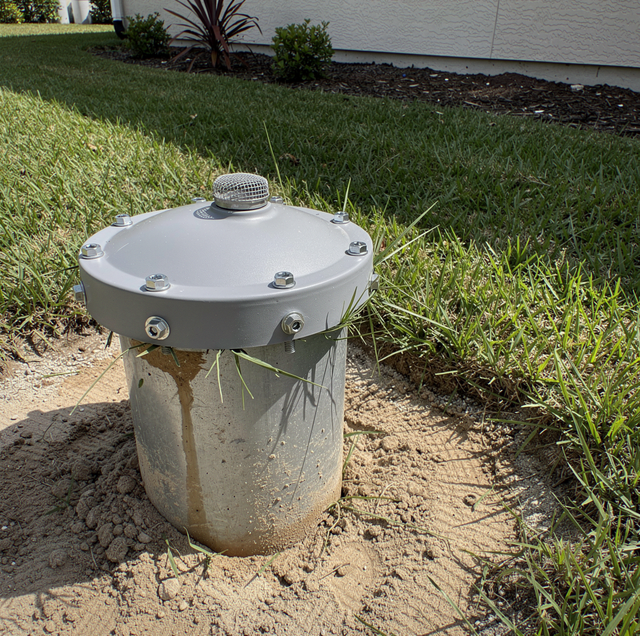
The cap on top of your well is a sanitary cap. It bolts to the casing, seats on a gasket, and carries a downward-facing screened vent that allows air to pass while closing the opening to water and insects. The pump wire enters through a fitting that closes around the cable.
Each of those parts is a place the seal can end, and one ending leads to the next. A gasket hardens and takes a set, so the cap no longer bears evenly on the rim; with the load off, the bolts lose their compression and back off, and the gap widens from there. The version with no aging in it is a cap set back on without its gasket after a pump job, which looks finished from ten feet away while standing open.
Water soaking down through soil is strained by every inch it passes through. Water running down the inside of a casing skips that, arriving in the time it takes to fall and carrying what it picked up as it crossed the ground.
Ground That Slopes Toward the Casing Feeds It
How much water reaches your cap depends on the ground the casing stands on. The intended arrangement is plain: the casing stands above the surrounding grade, and the soil falls away from it, so runoff moves off rather than collecting against the pipe. How far above grade it has to stand varies by jurisdiction and by the year your well was drilled, so that question belongs to your local health department or water management authority.
The physics does not vary. Ground settles, and the first to settle is the annular backfill placed around the casing when the well was finished. It consolidates for years, so the depression forms right at the pipe, and rain collects in it.
Work above ground does the same in an afternoon. Fill brought in to level a yard raises the grade around the pipe without anyone thinking about the well. Pavement goes further than raising it: a paved surface takes in no water, so everything that lands on the slab runs to its lowest edge, and a well on that side takes the whole of it.
Standing water against your casing has hours and head. A puddle six inches deep presses on the joint underneath it the whole time.
The Grout in the Annulus Is the Seal You Cannot See
A borehole is drilled wider than the casing that goes into it, leaving a ring of open space called the annulus. Left open, that ring runs from the surface down toward the water-bearing zone and offers less resistance than the packed soil beside it, so water takes it.
Grout closes that ring. Neat cement or bentonite is placed in the annular space and set, bonding to the casing on one side and the borehole wall on the other. Placed from the bottom up through a tremie pipe, it fills the space without trapping voids; poured from the top, it can bridge on an irregularity in the hole and leave an open pocket beneath it.
Grout also ages. Bentonite maintains its seal by staying hydrated and shrinks if the zone it occupies dries and rewetts; the bond between cement and steel can separate as the casing expands and contracts.
The casing wall is the other half of that seal. Steel corrodes from the outside, where it sits in wet soil, losing thickness until a perforation opens at the first depth reached by corrosion. That is the version with nothing to see at the surface: your cap is sound, your ground slopes away, and water is still entering below your feet.
Some Wells Follow the Rain Without Anything Being Broken
Not every rain-driven change is a defect. Unconfined aquifers are recharged directly by water soaking down from the land surface above them, while confined aquifers sit beneath a layer of low-permeability material that slows anything moving down. If your well is finished in an unconfined zone, it draws from water that stays in contact with the surface because of how the formation sits. Your well can be sound and still do this.
The rock matters as much as the depth. Where groundwater moves through pore spaces between grains, it travels slowly, and the material it carries is strained out along the way. Where it moves through fractures and dissolution openings in limestone, it runs in open channels, and a rainfall signal can reach a well within days with its suspended material still in it.
A well like that is doing what a well in that formation does, and nothing you fix at the wellhead will change it. Your choices are deepening or recasing to reach a zone the surface does not reach so quickly, or living with water whose quality moves with the weather. Which one applies depends on the depth your well was finished at and how much of it is cased.
Turbidity Is the Visible Half of the Question
Brown has a number behind it. Turbidity is measured by shining light through a sample and measuring how much scatters sideways rather than passing through, and it is reported in nephelometric turbidity units. It reports how much material is suspended, and identifying that material takes a different analysis.
The question that matters after surface water reaches your well is bacteriological, and invisible in the glass. A private-well panel starts with total coliform, bacteria that live in soil, on plants, and in surface water. A positive result indicates that surface material is reaching your water and does not, by itself, identify a sewage source. The panel then looks for E. coli, which lives in the intestines of warm-blooded animals and indicates fecal contamination. The safe level of E. coli in drinking water is zero.
An E. coli cell is a rod roughly 0.5 by 2 micrometers, and settling speed climbs with both particle size and density, so a glass that goes clear on your counter has dropped its sand and kept its bacteria.
Your well is not part of a public system, so nobody samples it on a set schedule for you. A certified laboratory runs the analysis; your local health department reads the numbers for your area. Disinfecting a well after an intrusion treats the water standing in the well. The opening that let it in is a separate repair.
Frequently Asked Questions
That call belongs to your local health department, the authority for private wells in your area, and to the lab's report. Meanwhile, what is useful is knowing what boiling does. Bringing water to a rolling boil acts on microorganisms. It does nothing to dissolved chemicals, and because boiling drives off water and leaves dissolved material behind, it raises their concentration.
It clears the fixture and the lines, and says nothing about the well. Run it from an outdoor spigot instead of a kitchen tap if you can, because sediment that reaches your water heater settles into the bottom of the tank and comes back days later when the tank is drawn down hard. Aerator screens catch the coarse end and clog.
Not on its own. Two wells a few hundred feet apart can be finished at different depths, in different formations, with different amounts of cased and grouted footage. What settles it for your well is the completion report the driller filed when it was constructed: total depth, the depth the casing was set to, and the grouted interval. You can request a copy from the office that holds the well records.
Yes, and the parts responsible age quietly. Grout bonds separate, gaskets take a set, and steel casing loses wall thickness from the outside until a perforation opens. Where a contractor suspects the casing itself, the tool is a downhole video camera lowered on a cable, which shows joints, splits, and inflow points on the casing wall from the inside, at a stated depth.
Because nitrate moves with the same water and only one of the two is visible. It is colorless and odorless, moves readily through soil, and passes through a sediment filter untouched. If runoff from fertilized ground or a septic drainfield reaches your well, nitrate comes with it. The drinking-water limit for nitrate is 10 milligrams per liter as nitrogen, and your lab reports against that figure.
Not with anything that closes it. Sheeting or tape over the cap looks like the obvious defense against rain, but it shuts the vent, which has to stay open to the air so the casing can breathe as your water level rises and falls. Drawing against a sealed casing creates a partial vacuum in the water column, and a cover taped on during a storm is easy to forget.
When brown water follows a storm, the wellhead is where a technician starts — cap, grade and annular seal, checked before anything gets treated. Fussell Well Drilling serves Polk County and Central Florida. Call (863) 984-3144.