
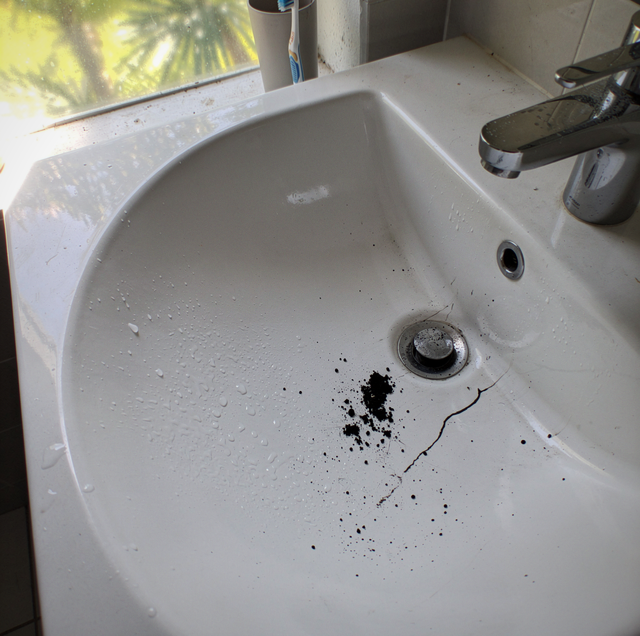
A few black flecks are sitting in the bottom of the sink after the faucet ran. Or a dark, stringy film comes off on a paper towel wiped around the inside of the toilet tank. Whatever it is, it is a physical object, and physical objects can be identified by hand.
Pinch one between a thumb and a forefinger. Whether it smears, crumbles, or bends tells you more in three seconds than an evening of reading, because a handful of materials account for nearly every case of black particles in well water, and no two behave the same way. The question is not what causes black water in general. It is what this piece of material is.
Four Questions Sort Almost Every Black Particle
Start at the tap, not at the lab. Four answers cut that list to one or two, and none cost anything.
Hot only, cold only, or both? This is the most useful question in the diagnosis. Run the cold side of the same fixture into a clean white bowl for two minutes. If only the hot carries black material, the heater is the first suspect, though a well carrying dissolved manganese can show there first simply because heat oxidizes it faster than an open tap does. If both sides carry it, the source sits ahead of the split: the well, the pressure tank, or the pipe between them.
One fixture or every fixture? Check a bathroom sink, the kitchen, a tub, and an outdoor spigot. Material at one fixture points at that fixture's own parts, its supply connector, its aerator screen, its angle stop. Material everywhere points upstream.
Slimy or gritty? Rub a piece between wet fingers. A biological growth smears into a film and leaves the skin slick; a mineral particle stays a particle and feels like very fine sand; failed rubber bends and flattens and refuses to break apart.
Continuous or intermittent? Material at every draw comes from something permanently in the water path. Material that appears for ten minutes after the irrigation zones run, then vanishes for three days, is being released rather than produced.
Take the sample from a faucet aerator, not the sink basin. Unscrew it and tap the screen onto a white paper towel for days' worth of what that line carries.
Manganese Turns Black Only After It Meets Air
Manganese is in the water long before it is visible. In the low-oxygen conditions of a limestone aquifer, it exists as a dissolved ion and is colorless, so water leaving the pump looks clear. The moment it meets oxygen at an open tap, or chlorine from an injection system, it oxidizes into manganese oxide, a solid. That reaction explains nearly everything odd it does: why a glass drawn clear carries black grit an hour later, why both taps can carry it, though the hot side often shows it first because heat drives the reaction faster, and why adding aeration or chlorination upstream can appear to make things worse before treatment removes it.
Manganese oxide is gritty, not slimy, and it sinks. Rubbed between wet fingers, it remains granular and washes off, leaving at most a faint brown shadow. Under good light it reads brown-black or purple-black rather than jet black, and it stains what it sits against, so porcelain darkens where water stands, and laundry comes out grey-shadowed. Chlorine bleach fixes those fabric stains rather than removing them, because it oxidizes the metal further; an acidic cleaner lifts what bleach sets.
Manganese is not purely an appearance problem. There are two numbers for two different reasons: a secondary standard of 0.05 milligrams per liter set for staining and taste, and a health-based lifetime advisory of 0.3 milligrams per liter, with a short-term advisory of 1 milligram per liter over ten days. Neither is enforceable on a private well, which is why a private well has no number attached to it until a lab produces one.
Iron and Sulfur Bacteria Make the Slimy Kind
This is the one that smears. Certain bacteria live by oxidizing dissolved iron and manganese, wrapping themselves in a gelatinous sheath as they do it. The colony grows on surfaces, not in the water: the casing wall, the drop pipe, the pump body, the pressure tank, and the downstream lines. What reaches the tap is a piece of the colony that let go, not an organism dissolved in your water.
Handled, it is unmistakable. It smears rather than crumbling, holds together in sheets or strings rather than dispersing into grains, and leaves a slick residue on the fingers. Color runs from rust-orange through yellow-brown to nearly black where sulfate-reducing bacteria are present, and iron sulfide has formed. It plugs aerator screens with a soft mass instead of grit, and coats the walls of a toilet tank, where water stands still for hours. It is at its worst at the first draw of the morning, and an odor often accompanies it, swampy or oily; a persistent rotten-egg smell is a diagnosis in itself.
Do not pull the well cap to look for slime. That cap is the sanitary seal, and lifting it drops surface debris and insects straight down the casing. A well contractor breaks and reseals it under controlled conditions.
These organisms are not themselves proof that the water is harmful, and their presence alone is not a health finding. It does mean something has established itself inside the well, which is a reason to test rather than assume. Shock chlorination is the standard treatment for a colony living in a well and its plumbing, and it entails handling requirements that make it unsuitable for a casual afternoon.
Rubber Fragments Bend Instead of Crumbling
Elastomers fail from the inside out. Braided supply connectors have a rubber liner inside the stainless sleeve; washing machine hoses are rubber throughout; and gaskets, hose bibb washers, expansion tank bladders, and toilet flappers are in the same family. As the polymer breaks down, the liner sheds black fragments into the water.
Two things speed that up. Heat is one reason the hot side almost always goes first. Chlorine and chloramine are the other, and on a private well that means either an injection system running continuously or the weeks after a shock treatment, while residual chlorine still works through the plumbing.
Rubber is the easiest of them to identify, because the flakes are flexible. Press one with a fingernail, and it flattens rather than powders. Their edges look torn rather than granular, their sizes are irregular, and many hang in suspension or ride the surface. They neither smear nor crumble. Location finishes the job, since one failing part serves one run. A toilet flapper is the clearest case: it sits downstream of every sink, so flapper material blackens the tank and bowl and can never appear at a faucet.
Hot Water Only Points at the Water Heater
If the cold runs clean everywhere and only the hot carries black material, three things inside the tank produce it.
The first is the sacrificial anode rod. It is there to corrode instead of the tank, and that is what it does: aluminum and aluminum-zinc anodes shed a soft grey gel that darkens as it picks up iron and manganese from the tank, which then settles to the bottom and lifts whenever the tank is disturbed. The second is bacterial: sulfate-reducing bacteria in a warm tank consume the hydrogen released at the anode surface, producing hydrogen sulfide, which reacts with iron to form black iron sulfide sludge. The third is plain tank sediment, hardness scale precipitated by heat mixed with whatever iron and manganese the water brought in, baked into a dark layer on the tank floor.
The tells are simple. The material is soft and dark rather than gritty, and it arrives in a slug when hot water is drawn hard, then thins out. One useful negative: a failing older polypropylene dip tube sheds curls of white or grey plastic, so white flakes on the hot side point somewhere else entirely.
Carbon Fines Follow a Filter Change
Granular activated carbon is black by nature, and a cartridge or tank sheds material under three conditions: a new cartridge put into service without being flushed, an old one run past its rated volume until the granules abrade against each other, and a failed retention screen dumping media into the line.
Carbon fines look different from mineral grit under light. They are uniform, true jet black rather than brown-black, and much lighter, so a fraction float on the surface of a glass while the rest settle and feel gritty in the fingers.
Timing and position identify them almost by themselves. Black material appearing the same day a cartridge was changed, then fading over the following days of use, is carbon; a new cartridge needs a flush of a stated number of minutes or gallons before it goes into service, and skipping it is the commonest cause. Carbon fines also reach only taps downstream of the filter, so a hose bibb plumbed ahead of the unit runs clean while interior fixtures carry black grit.
Stirred Sludge and Pipe Scale Arrive in Bursts
Some black material is not being made; it is being released. Manganese and iron sludge settles anywhere the water slows: the bottom of the borehole, the floor of the pressure tank, the low points of a long pipe run. Each pump start surges through those places, lifting part of it.
Heavy demand does it a second way. Sustained irrigation, or several fixtures at once, draws the standing water level in the casing down toward the pump intake. With less water above it, the pump draws from a zone that carries more fine material off the borehole wall, and a pump set close to the bottom picks up silt it would otherwise never reach. Both halves of the year contribute: a dry stretch lowers the standing level, and heavy rainfall pushes turbid water through solution channels in limestone.
Corroded steel is the other source of bursts. Galvanized supply lines, steel casing, and steel drop pipe corrode from the inside where oxygen is scarce, and the product is magnetite, a black iron oxide that builds hard scale on the pipe wall and holds there until something disturbs it: a pressure change, a repair upstream, a fixture nobody has run in a month. Pressed with a fingernail, it crushes into angular fragments with flat faces rather than powdering, smearing, or bending, and it is far likelier in a house plumbed in galvanized steel than in copper, PEX, or CPVC.
Stirred sludge is usually the same manganese oxide described earlier, so grit and smear tests will not separate the two. Timing does. Clean for days, black for ten minutes after the zones cycle, then clean again, is a release pattern rather than a chemistry pattern. General cloudiness and steady tan sediment are a different diagnosis from black specks.
What the Testing Actually Settles
Nothing above tells you whether to drink the water, and no article should. What the sorting does is tell you which test to buy so the result means something.
Three tests cover the ground. Total coliform and E. coli address the biological question, and they are the only ones on this list that speak to contamination rather than to material. Iron and manganese quantify the metals, turning a visible stain into a number that can be checked against the standard. Sulfate and hydrogen sulfide matter where the material is black and odorous together. Use a laboratory certified by the state, since the certification makes the number defensible.
Ask the lab for both total and dissolved manganese from the same sample. Dissolved means the metal was still in solution when it left your tap. A high total with a low dissolved figure means the particles formed upstream.
A rust-orange stain on porcelain is an iron question rather than a black-particle one, and which treatment to install is a separate decision that only makes sense once numbers come back.
Frequently Asked Questions
Use a magnet. Let the sample settle in a clear glass and slide a strong magnet along the outside of the base: magnetite drags with it, and manganese oxide does not move. The two settle differently as well, since scale chips drop fast and land as visible flakes while manganese oxide forms a fine layer that clouds when the glass is nudged. PVC casing and polyethylene drop pipe cannot make magnetite, which narrows the question to the house plumbing.
The pressure tank is where sludge settles between cycles, and an outage draws it down further than normal use does. When power returns, the pump refills against an unusually low tank and the restart surge lifts whatever rested on the floor. A tank that has lost its air charge multiplies this, since it short-cycles the pump and repeats that surge dozens of times an hour.
Black particles alone do not answer that, and the test that does is reported differently from a metals test. Coliform is a presence or absence result rather than a concentration, and a total coliform positive is normally followed by an E. coli confirmation separating environmental organisms from fecal indicators. Your county or state health department keeps the list of certified laboratories.
A cartridge captures particles passing through it, but a colony living downstream keeps growing and re-seeds the line behind it. The housing becomes a growth site of its own, since it holds standing water at room temperature between draws. A filter plugging with soft mass every few weeks rather than filling with grit is itself a sign the problem is biological.
Use a dry white paper towel. Carbon fines wipe off as a grey smear and leave nothing once the towel is brushed clean. Manganese oxide leaves a brown-black mark that stays in the fibers and will not wipe away, because it is a stain rather than loose powder. That is why manganese marks porcelain and carbon rinses off.
Heat speeds the oxidation reaction, so a house carrying dissolved manganese often finds the water heater collecting it first. Draw a few gallons from the heater's bottom drain valve and the water can run black while every cold tap looks clear. That is the exception to the hot-only rule: hot-side material usually means the heater, but occasionally the heater is just the first place the well's own metal became visible.
Have the water tested and the well inspected — identify the material, then treat the actual source instead of the symptom. Fussell Well Drilling serves Polk County and Central Florida. Call (863) 984-3144.
