
How a Well Water System Works: 8 Key Parts
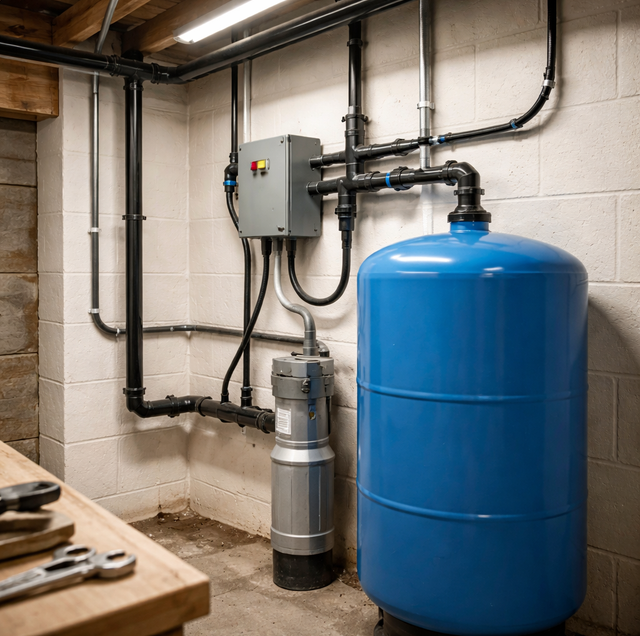
Quick Answer: A well water system draws water from an underground aquifer through a pump, stores it under pressure in a tank, and delivers it to the house on demand. The pressure tank, pressure switch, check valve, and pitless adapter keep that flow steady and protect the pump, and treatment equipment cleans up iron, sulfur, or hardness before the water reaches a tap.
A private well runs a small waterworks on your own property. There is no city main and no monthly utility bill for the water itself. Instead, a pump pulls water from an underground aquifer, a tank holds that water under pressure, and the whole setup pushes water to your taps the moment you turn one on. Once you see how the water travels and which part handles each job, a lot of common well problems start to make sense.
From the Aquifer to Your Tap
Before naming the parts, follow the water. Rain and surface water soak down through soil and rock until they reach a saturated zone underground called an aquifer. A well is a hole drilled down into that saturated zone, deep enough to sit well below the water table so it keeps producing even when the level dips.
A pump lifts that water up out of the well and pushes it toward the house. On the way, it fills a pressure tank that stores a reserve of water squeezed under air pressure. When you open a faucet, that stored pressure sends water to the tap right away. As the tank empties and pressure falls to a set low point, the pump switches on, refills the tank, and shuts off again at a set high point. So the water path is short and repeatable: aquifer, well, pump, pressure tank, house piping, tap. Every component below sits somewhere along that line.
The Key Parts and What Each One Does
The Well and Casing: The well is the drilled shaft itself, usually lined with a pipe called casing. The casing holds the borehole open so it does not collapse, and it seals out surface runoff, insects, and dirt that would otherwise foul the water. Near the bottom, a screen or an open section of the aquifer lets groundwater flow in while keeping out sand and gravel.
At the top sits a sanitary well cap, a vented, gasketed cover that keeps rain, bugs, and debris out while letting air pressure equalize as the water level moves. That cap is a contamination barrier, not just a lid. Removing it exposes the water supply, and a well is a confined space that can hold low-oxygen air or gas, so cap and downhole work belongs to a licensed contractor, never a homeowner.
The Aquifer and Water Table: The aquifer is the water-bearing layer of sand, gravel, or fractured rock the well draws from. The water table is the top of the saturated zone. Both move up and down with rainfall and with how much water is being pumped nearby. A well is drilled deep enough to keep the pump submerged even during a dry stretch, which is one reason two wells on the same street can have very different depths.
The Pump: The pump is the muscle of the system, and it comes in two main styles.
A submersible pump is a sealed motor-and-pump unit lowered on the drop pipe down into the water itself, often hundreds of feet down. It pushes water up from below, which is efficient and quiet because the motor is underwater and out of sight. Most modern and deeper wells use this type.
A jet pump sits above ground, usually in a well house, garage, or basement, and pulls water up by creating suction. Shallow-well jet pumps handle modest depths on their own, while deep-well jet pumps use a second pipe and a downhole jet assembly to reach farther. Suction has physical limits, so jet pumps suit shallower wells, while deeper wells lean on submersibles. Either way, pump wiring runs near water, which makes it a genuine shock hazard, so a pro should handle the electrical and any control box.
Pump wiring runs near water, which makes it a genuine shock hazard, so a pro should handle the electrical and any control box. Any electrical trouble, a tripping breaker, or a control-box fault is a call for a licensed pro, not a DIY fix.
The Pressure Tank: The pressure tank is what keeps your pump from starting up every single time you crack a faucet. Inside sits an air bladder or an air cushion above the water. As the pump fills the tank, water compresses that air; when you open a tap, the compressed air pushes water back out under pressure without the pump running at all.
Most home systems are set to cut in and cut out across a fixed band, commonly 40/60 psi. The pump kicks on at the 40 psi low point and shuts off at the 60 psi high point, then the tank coasts on stored pressure until the next refill. A healthy tank holds a good slug of water in reserve, so short draws never touch the pump. When the air charge is wrong, or the bladder fails, the tank goes waterlogged, and the pump starts short-cycling, snapping on and off rapidly, which wears the motor out fast and needs prompt attention.
The Pressure Switch and Gauge: The pressure switch is the small electrical control that watches tank pressure and tells the pump when to run. It closes the circuit and starts the pump at the cut-in pressure, then opens it and stops the pump at the cut-out pressure. Those two set points are what the 40/60 numbers refer to.
The pressure gauge is the dial that shows current system pressure at a glance. A needle bouncing rapidly between the cut-in and cut-out marks is the classic sign of short-cycling, and a reading stuck low or pinned high points to a switch, tank, or supply issue worth a service call.
The Check Valve: A check valve is a one-way gate in the line that lets water flow up toward the house but blocks it from draining back down into the well when the pump stops. Without it, the column of water in the drop pipe would fall back after every cycle, so the pump would have to re-lift the same water again and again, and the tank could lose its prime. Many systems use more than one, including one at the pump and sometimes another up the line.
The Pitless Adapter: The pitless adapter is a fitting that carries water from the vertical well casing sideways into the buried service line to the house, all below the frost line. It makes a sealed, watertight connection underground so the plumbing stays frost-protected and the wellhead stays sanitary, without an old-style below-grade well pit that could flood and contaminate the supply.
Treatment Equipment: Well water arrives untreated, so many homes add conditioning based on a water test. A water softener swaps out the calcium and magnesium that cause hardness and scale. A sediment or carbon filter catches grit or reduces taste and odor. For water heavy in iron or hydrogen sulfide the rotten-egg smell, a system might add an air-injection filter or a chlorinator that doses a small amount of chlorine to oxidize the minerals so they can be filtered out. Which pieces you need depends entirely on what the test finds, not on a generic package.
How the System Cycles
Put it in motion, and the choreography is simple. You open a tap. The pressure tank delivers stored water immediately, so flow starts without delay. As water leaves, tank pressure drops. When it reaches the cut-in point, the pressure switch starts the pump, which draws from the aquifer and refills the tank while still supplying the tap. When you close the faucet and pressure climbs to the cut-out point, the switch shuts the pump off. The check valve holds the water column in place, and the tank sits fully charged and ready for the next draw.
That cycle repeats every day, and its rhythm is a useful gauge of system health. Long, steady runs during a shower are normal. Rapid on-off snapping during a small draw is not, and it usually traces back to the pressure tank or switch.
Basic Care That Keeps It Running
A private well trades a utility bill for a bit of owner attention, and the maintenance is light but real.
Think of the pressure tank like a spare tire holding air. When the air pressure slips out of range, the system limps and eventually strands you, so it pays to keep an eye on it. A yearly walk-around covers most of what matters: check the gauge behavior, listen for a pump that cycles too often, and glance at the wellhead.
Tip: Keep the area around the wellhead clear and sloped so runoff drains away from the casing, and keep chemicals, fuel, and fertilizer well back from it. Test the water at least once a year for bacteria and nitrates, and again any time the taste, color, or smell changes.
One more reality worth planning for: a well runs on grid electricity. No power means no pump and no water unless you have a generator or backup ready, which is why many rural owners keep a plan for outages. And because pump wiring lives around water, any electrical trouble- a tripping breaker or a control-box fault is a call for a licensed pro, not a DIY fix. Address short-cycling and pressure swings early. A waterlogged tank or a switch left snapping will burn out a pump that would otherwise last for years.
Frequently Asked Questions
A submersible pump commonly runs 8 to 15 years, and a surface jet pump often lands in a similar range, though hard, sandy, or iron-heavy water and frequent short-cycling shorten that life. Pressure tanks often outlast the pump but eventually lose their bladder, so it is common for a pump swap to be a good moment to check the tank's air charge and age.
Sizing follows drawdown, the amount of water the tank delivers between cut-in and cut-out, rather than the tank's total volume. A rough rule aims for at least one gallon of drawdown per gallon-per-minute of pump output, and installers often target a pump run time of a minute or more per cycle to avoid short-cycling. A larger tank means fewer pump starts and longer motor life, which is why oversizing slightly is common.
Not without a backup power source. Because the pump is electric, the water stops when the grid does, aside from the small reserve already in the pressure tank. A properly sized portable or standby generator can run the pump, but the transfer connection and the pump's electrical load should be set up by a licensed electrician or well pro so the wiring stays safe around water.
Air at the tap can point to a water level dropping to the pump intake, a leak on the suction side of a jet pump, or a failing check valve letting the drop pipe drain down between cycles. It differs from a waterlogged tank, which shows up as rapid pump cycling rather than air in the line, so the fix depends on which symptom you actually have.
Depth varies widely with local geology and the water table, ranging from under 100 feet to several hundred feet, because the driller has to reach a reliable saturated zone and stay below it during dry spells. Two neighboring properties can need very different depths, which is why a new well is quoted only after the driller evaluates the site rather than from a standard number.
Test at least annually for total coliform bacteria and nitrates, and retest immediately after flooding, nearby construction, a new pump installation, or any change in taste, odor, or color. Periodic broader testing for iron, hardness, pH, and hydrogen sulfide guides whether you need a softener, filter, or chlorinator, since untreated well water is not monitored by any utility on your behalf.
Not sure your pump or tank is behaving the way it should — a quick professional check can catch short-cycling or a failing tank before it strands you. Fussell Well Drilling serves Polk County and Central Florida. Call (863) 984-3144.
