
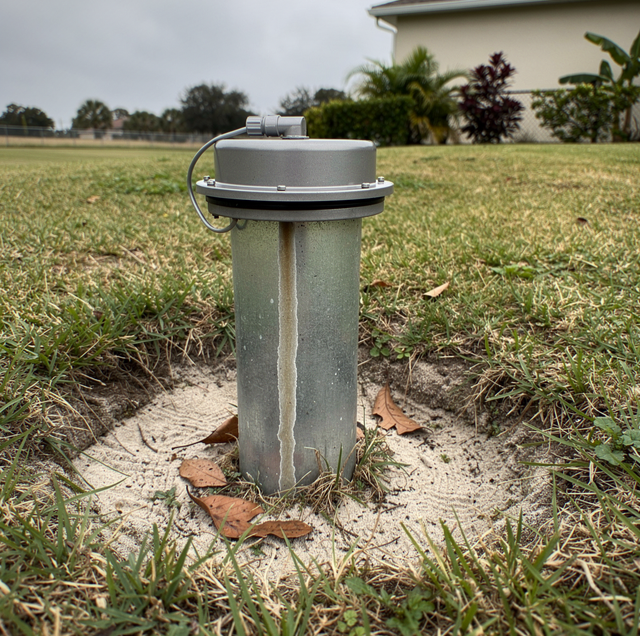
A well and a well pump are not the same thing, though it is easy to blur the two together once the water starts acting up. The pump is a motor that can be pulled, serviced, and swapped out. The well is the hole in the ground around it: a length of casing sealed into the earth, a screen or open section near the bottom where water actually enters, and the aquifer underneath supplying everything that comes up through it. Ask how long a well lasts, and you are really asking about three separate things aging on three separate clocks.
The Casing Ages by Corroding or Cracking
Casing is the pipe lining the drilled hole, sealed at the top to keep surface water and shallow contamination from tracking down alongside it into the aquifer below. Nothing about that pipe moves, and it fails in one of two ways.
Steel casing corrodes. Water chemistry aggressive enough to attack metal thins the pipe wall from the inside out until it pits, then perforates. PVC casing does not corrode, but it can crack or shift where ground movement or a poorly grouted seal puts stress on a joint that was never designed to flex. Neither failure produces a symptom at the tap right away. A cracked seal near the surface can let shallow water and grit into the casing before anyone notices sediment creeping into the plumbing, because the leak point sits below grade, out of sight, doing its damage quietly.
The Screen or Open Hole Narrows as It Ages
Near the bottom of the casing, water enters the well through a screen, a slotted or wire-wrapped section of pipe, or, in some rock formations, an open borehole with no screen at all. That opening is the only path water has into the well. Unlike the casing above it, this part narrows: the open area available for water shrinks a little at a time, and the well produces less water for the same effort even though nothing about the borehole itself has physically broken.
A well experiencing this kind of narrowing falls gradually, since the closing happens a fraction of the opening at a time. A driller confirms it with a camera survey of the screen and a pumping test of the well's output.
The Aquifer Sets a Ceiling the Well Itself Cannot Change
Everything above this point assumes that the aquifer beneath the well continues to supply water as it always has. That assumption does not always hold, and when it does not, no amount of casing integrity or screen cleanliness can fix it because the water supply feeding the well has changed.
A dry stretch can draw the saturated zone down below a well's intake, leaving it unable to keep up; in ground where the water level holds steady through the seasons, that particular risk is small. The distinction matters for correctly reading a symptom: a well that starts producing less during a stretch of little rain and recovers once rain returns is reporting on the aquifer rather than on itself. A well that keeps declining regardless of rainfall, through wet months and dry ones alike, points to something structural in the casing or screen instead, because a healthy aquifer would have let the water level recover by then.
A second version of the same problem arises when many wells share a single aquifer. When many wells draw from the same layer, a decline can appear across all of them at once rather than in just one. A homeowner troubleshooting a single well's declining output benefits from knowing whether neighboring wells drawing from the same aquifer are experiencing the same issue, since a shared regional decline calls for a different response than a problem isolated to one well's casing or screen.
The Wellhead and Seal Age Quietly, with No Warning at the Tap
The wellhead, the fitting and cap where the casing meets the surface, and the sanitary seal around it are easy to overlook because a failing wellhead does not always change how the water tastes or how strong the pressure runs. What it does instead is open a path for exactly the kind of contamination the casing was built to keep out. A cracked seal, a cap that no longer sits tight, or a wellhead standing in a low spot where water pools after storms can all allow surface runoff to track along the outside of the casing during heavy rain, bypassing the protection the well was built with in the first place.
A casing that stands above grade with the ground sloping away from it, sealed and capped correctly, sheds that water instead of letting it in.
A loose or cracked well cap lets insects, runoff, and surface bacteria into drinking water, and the wiring under the cap is live. Keep the cap on and let a licensed well contractor open and reseal it.
What Decides Maintain, Rehabilitate, or Drill Again
Once a well is actually declining, the casing, the screen, and the aquifer point to different answers, and telling them apart is a professional's job rather than a guess based on symptoms alone. A well with sound casing and a healthy aquifer but a narrowed screen is a strong candidate for redevelopment, the mechanical and chemical process that clears an opening rather than replacing the structure around it. A well with corroded or cracked casing, or one whose aquifer has dropped permanently, is a different case, since neither a clean screen nor a new pump can fix a structural failure or a water source that is no longer there.
Note the months when output dips and whether it comes back after rain. That pattern is the first thing a driller uses to separate an aquifer change from a casing or screen problem.
Reading Your Own Well's Age Correctly
A well's age in years answers only part of the question. Well contractors commonly cite a working life measured in decades for a well built and sealed correctly in stable ground. A well fighting corrosive water, a shifting formation, or a falling water level can show a structural problem at any point in that range, regardless of how many years are on the calendar. What actually answers the question is a driller looking at the casing, the screen, and the water level against the record from when the well went in. That comparison tells a homeowner whether they are looking at years of service still ahead or a structure that has reached the end of what it can do.
Frequently Asked Questions
Not on its own. A general home inspection may run the taps and look at the wellhead; a well contractor's inspection adds a flow test, a water-level measurement, and, where needed, a camera survey of the casing and screen.
Not always. Site conditions such as spacing from an existing septic field, a property line, or a structure can rule out drilling a replacement well in the exact location of the old one, which is why a driller evaluates the whole site rather than assuming the original spot is still available.
Often, yes: a smaller liner casing is set inside the damaged section and sealed in place, rather than pulling and replacing the original pipe. Whether that liner still works depends on how much the smaller inner diameter reduces the well's output, which a driller confirms with a camera survey before recommending it over a full casing replacement.
Yes. An old well that was never properly plugged and grouted can act as a conduit for surface water and contaminants to reach the same aquifer that a working well draws from, so a properly abandoned neighboring well is part of what protects a nearby well's water source, not just a separate property's leftover problem.
On some well constructions, yes. A well built with a retrievable screen assembly inside the casing can sometimes have just that screen pulled and replaced without redrilling the borehole itself, though this depends entirely on how the well was originally constructed and is not an option on every well type.
Sometimes, but not as-is. Water standing in an idle well can pick up bacteria and the pump can seize, so a contractor checks the pump, the cap and seal, and has the water tested before the well goes back into service.
Get a well evaluation that looks past the pump — a driller can tell a clogged screen, a corroding casing, and a truly low aquifer apart before you commit to a fix that will not solve it. Fussell Well Drilling serves Polk County and Central Florida. Call (863) 984-3144.