
What Happens to Your Well When the Power Goes Out
Quick Answer: A private well pumps with an electric pump, so no power means no pumping. You will still get a little water at first because the pressure tank holds a small pressurized reserve. Once that reserve bleeds off, the taps go dry until power returns or a backup power source runs the pump.
The lights flicker off, and a few minutes later, you go to wash your hands, and the faucet trails off to a trickle. For a home on city water, an outage is an inconvenience. For a home on a private well, it can also mean the water stops, because on a well, the two are wired together in a way most people never think about until the power is out.
Understanding why that happens, and what still works in those first few minutes, takes the panic out of it. It also makes the difference between an outage you ride out and one that leaves you hauling buckets.
Why No Power Means No Water
A private well is not a spring you can dip into. The water sits far below ground, and the only thing lifting it up to your house is an electric pump, usually a submersible unit hanging deep in the well casing. That pump does all the work of pushing water up the well and into your plumbing. Cut its power, and the lifting stops instantly. There is no gravity feed, no municipal pressure behind it, nothing to move water the moment the motor is dead.
So the honest answer is the simple one: when the power goes out, your well stops making water. Everything you get after that first flush is borrowed from a reserve you may not even know you have.
The Pressure Tank Is Why You Still Get a Trickle
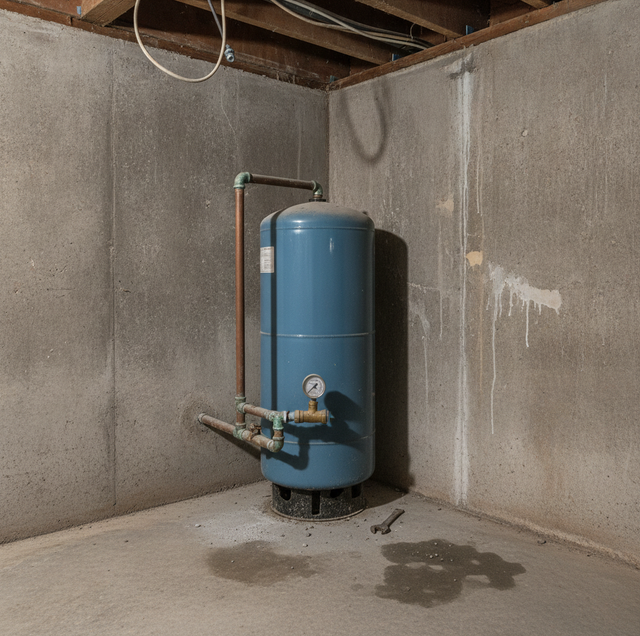
Here is the part that surprises people. For a minute or two after the power dies, the taps still run. That water comes from the pressure tank, the tall metal cylinder sitting near your pump controls or in the utility room.
Think of the pressure tank the way you would a scuba diver's air tank: it holds a supply already under pressure, ready to deliver on demand without anything running at that moment. Inside the tank, an air-filled bladder presses against a volume of stored water. While the pump runs, it fills the tank and compresses that air. When you open a tap, the compressed air pushes the stored water to your fixtures, which lets your pump cycle on and off instead of running every time you use water.
During an outage, that stored, pressurized water is all you have. It is usually enough for a few toilet flushes or a short run at the sink, not gallons and gallons. As you draw it down, the air behind the bladder expands, the pressure drops, and the flow weakens until it stops. At that point, the tank is spent, and nothing more will come until the pump can run again. This is normal. It is not a sign that anything is broken.
Your Options for Backup Water
Once you understand that the pump is the whole game, the ways to keep water flowing all come down to one of two ideas: power the pump anyway, or have water set aside that does not need the pump at all.
A generator sized to start the pump- This is the most common answer for people who lose power often. A generator, whether a permanently installed whole-house unit or a portable one, can run the well pump through an outage. The catch is sizing, and it is a bigger catch than most buyers expect. More on that below, because it is the single most common reason a generator disappoints its owner.
A manual or solar hand pump- Some well owners fit a backup hand pump alongside the existing submersible, or a small solar-driven pump. It will not fill a bathtub quickly, but it can draw drinking and cooking water straight from the well with no grid power at all. It is the fallback that continues to work when the fuel runs out.
Water stored ahead of time- The lowest-tech option is also the most reliable. When an outage is expected, fill jugs, pots, and a bathtub before it hits. Stored water needs no pump, no fuel, and no wiring. Even a modest stash covers drinking, cooking, and flushing for a day or two.
Which of these fits depends on how often your power goes out and how much water you need to keep flowing. Many households end up with a mix: stored water for the short blips, a generator for the long ones.
Sizing a Generator for a Well Pump
If you go the generator route, this detail determines whether it works. A submersible well pump does not draw a steady, predictable amount of power. At the instant it starts, the motor pulls a surge of current far larger than what it needs once it is spinning, and a generator that only matches the running number will choke and stall the moment the pump kicks on.
The fix is to size the generator to the startup surge, not the running watts, and to confirm the numbers against your specific pump rather than a rule of thumb. A pump that is comfortable to run steadily can still be too much to start on an undersized generator. This is exactly the calculation a well professional can run for you, matching generator capacity to your pump's real startup demand so it actually carries the load instead of tripping every time the tank calls for water.
The Two Safety Rules That Matter Most
Backup power around a well touches two things that hurt people every year, so they are worth stating plainly.
Never backfeed a generator into your house wiring- Plugging a generator into an outlet to energize the home, sometimes called backfeeding, sends power backward onto the utility lines. That can electrocute a lineworker trying to restore your service, and it can wreck your equipment when grid power returns. The safe connection runs through a proper transfer switch or an interlock kit at the panel, and that is a licensed electrician's install, not a weekend project.
Do not let the well run dry- A submersible pump uses the water around it to stay cool. Push it to keep pumping when the well or the tank has run empty, and the motor can overheat and fail. This is one more reason to conserve during an outage: going easy on water is not just about making the reserve last; it protects the pump you are relying on.
After the Storm: Check the Water Itself
Outages come from all kinds of causes year-round, such as a blown pole fuse, a car into a pole, an ice storm on the lines, a summer thunderstorm, or a hurricane rolling through. Most of those leave the water underground untouched, and once power returns, the well simply goes back to work.
Flooding is the exception, and it is the one to take seriously. If floodwater rose to or over your wellhead, it may have carried surface contamination down into the well. In that case, the water should not be assumed safe just because it looks clear. Have it tested, and disinfect the well if the results call for it, before anyone drinks or cooks with it again. Clear water can still be unsafe water after a flood, and the only way to know is to check.
Conserving While the Power Is Out
Until service is back or a backup is running, stretch what you have. Flush only when needed. Skip the dishwasher and laundry. Keep a little of your stored water aside strictly for drinking. The less you draw, the longer any reserve lasts and the less strain you put on the system when it comes back online. An outage handled calmly is mostly a matter of expectations, and now you know what to expect.
Frequently Asked Questions
How much reserve you actually get comes down to the pressure tank's drawdown, the usable volume it releases between its cut-in and cut-out settings. On a common 40/60 switch, the tank refills at 40 psi and stops at 60, and only the water stored across that band comes out with the pump off. A larger tank or a wider pressure spread holds more usable water before it runs out, which is why two homes can run dry at very different rates during the same outage.
Size it around the starting surge, which for a submersible pump commonly runs about 3 to 5 times its running amps. A pump drawing roughly 10 running amps can spike to 30 to 50 amps the instant it starts, and that momentary surge is the number the generator actually has to cover. A unit matched only to the running figure will brown out and stall when the motor kicks on. Check the amp draw stamped on your pump or control box and pick a generator with headroom above the surge, not just the run.
Not automatically, and boiling one kettle will not settle it. Have a bacteriological test run, the coliform test, since that is what confirms whether the well has been contaminated. If it did, the fix is to shock-chlorinate the entire well, disinfecting the casing and the water column rather than just the tap, because the problem lies in the well itself, not just at the faucet. Retest after disinfecting before anyone drinks or cooks with it.
No. The transfer switch or listed interlock has to isolate the well's dedicated 240-volt circuit so generator power cannot flow back onto the utility lines. A manual transfer switch handles this for a portable generator, while a standby unit uses an automatic transfer switch that senses the outage and starts on its own. Either way, it is a licensed installation because backfeeding through a regular outlet can electrocute a lineworker and wreck your equipment when grid power returns.
It can. A submersible pump depends on the surrounding water to dissipate heat, so running the well or tank dry can cause the motor to overheat and burn out. One worthwhile safeguard is a low-water cutoff, sometimes sold as a pump-saver control, that senses a drop in level and shuts the pump off before it runs dry. On a well that is prone to outages or low yield, adding one is cheap insurance against a dead motor.
Store water ahead of a known outage in jugs, pots, or a filled bathtub. Fit a manual or solar-powered hand pump that can draw from the well without grid power. Or add a larger pressure or storage tank so the reserve holds more and lasts longer between pump runs. Many homes combine a couple of these for both short and long outages.
Ask about backup and generator sizing for your pump, so an outage never leaves you without water. Fussell Well Drilling serves Polk County and Central Florida. Call (863) 984-3144 for well and pump service.
