
The Full Sequence: What's Involved in Drilling a New Well
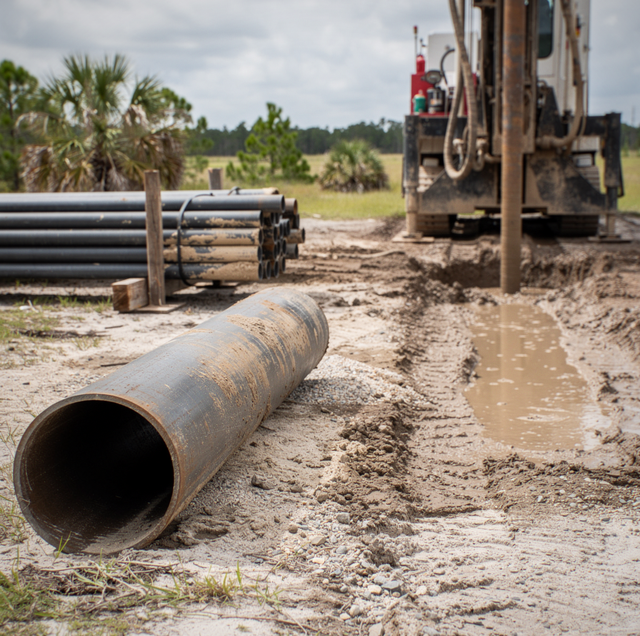
The rig comes level on its pads, the mast goes up, and the first length of drill pipe turns into the ground while you stand off to one side, watching. For hours or days, the job looks like a machine making a hole. Underneath, it is a sequence, and each step closes the ones before it. The hole deepens. Casing follows the bit down. Material washes back to the surface and shows the crew what it is cutting through. Your part ended earlier, on the day the wellhead location was fixed and the paperwork filed. From here on, every remaining choice follows what the drilling finds, and by the time the rig leaves your parcel, a well has been built inside the hole.
Siting the Well Happens Before the Rig Arrives
A rig makes a hole. The hole is temporary: an open borehole in soil or rock begins to degrade the moment the bit passes, and nothing about it is meant to last. The permanent object is the well, and the well is a structure assembled inside that hole while the hole is still good. Everything that follows on the pad is that assembly, done in one pass, with the ground supplying conditions and the crew the judgment.
The one part of the job under your control comes before any of it. The wellhead location is fixed first, and the questions that shape it concern the surface: how far the head sits from a drainfield, a fuel tank, an animal pen, or a low spot that collects runoff, and how the ground around it will drain afterward. The permitting paperwork is at the same stage and is handled as part of the job.
Filed well records from the surrounding area are the closest thing to a preview. Every well that gets finished leaves a written log behind it, and those logs name the materials found and the depths they were found at. Read together, they describe what a bit is likely to meet in a neighborhood. A parcel can differ from its neighborhood, so the hole on your property stays its own record until it is drilled.
Once the mast goes up, the useful questions stop being yours and start being the formation's.
Casing Depth Follows What the Bit Finds
Casing is steel or plastic pipe run into the hole behind the bit. It does two jobs at once. It holds open the length of hole that will not stand on its own, and it separates everything above from the water your well is built to draw. Both jobs are structural, which is why the casing goes in while the drilling is still underway.
How far down it runs is not a figure chosen at a desk. The crew keeps running casing until the hole stands in material that behaves, and the point where that happens comes out of the hole instead of off a plan. Penetration rate changes. The returns change color and texture. The hole starts taking fluid or giving it back. A driller reads those signals together and lands the casing where the ground will hold it, which is why the depth on your finished record was not knowable the week before.
After that, the cased length is finished work. Nothing above the bottom of the casing can be reached again without taking your well apart, which is why a driller would sooner run extra than come short.
Sealing Around the Casing Is a One-Way Step
A bit cuts a hole wider than the pipe that goes into it, leaving a ring of open space outside the casing once it is set. That ring is filled and sealed while the casing goes in, and the timing is the whole point: the space is reachable only during that window. Surface water must never be able to run down the outside of the casing and reach the zone your well draws from, and the seal is the only thing between the two.
The consequence for you as an owner is that the sealing step is judged on the day it happens, by the crew doing it and by what goes onto the written record. There is no later inspection that reopens it.
Reading the Cuttings Places the Intake
A well needs an opening for water to enter. In sand and gravel it is a screen, set against the water-bearing material. In rock, many wells are finished open hole, with no screen at all, and the rock face serves as the intake. Which one it gets depends on the material the hole passes through, and is unknowable until the bit reaches it.
Everything the bit cuts comes back up to the surface, carried up by fluid or air, and the crew reads it as the hole goes down. The order in which it arrives becomes the log: sand, then clay, then shell, then rock, each at its own depth. Where water enters the hole is noted as it happens, because that observation cannot be recovered later. The intake is then placed against the interval that produced it, and its position comes from that running record rather than from a drawing made before the rig arrived. In a formation yielding from fractures instead of from the spaces between grains, the producing band can be narrow, and drilling through it is the only way to find it.
Once the intake is in position, the section of hole below the casing is committed. Your well's opening is where the drilling put it, and no later work on your well will move it.
Development Turns a Finished Hole Into a Well
Drilling is a violent process at the scale that matters. The bit grinds material into fines, the circulating fluid pushes some of those fines into the formation face, and the wall of the hole ends up smeared with a layer of its own debris. A hole in that condition will pass some water, but it is passing it through an obstruction the drilling created.
Development clears that. It works by removing drilling mud, cuttings, and loose sediment from the bottom of the well and around the screen, thereby promoting the flow of water into the well. Removing that fine-grained material from around the casing also improves the well's yield. In practice, the well is worked harder than it ever will be once it is serving your house, with flow driven back and forth through the intake until the water runs clear. This is the well's first development, done once while the rig is still on the pad, and a separate job from the redevelopment an aging well may get years later.
Until it is finished, nothing you measure at the wellhead describes the aquifer your well draws from. It describes the mess the drilling left in front of it.
What Happens During the Yield Test at the End?
With the well developed, it is pumped at a steady rate for a sustained stretch while someone watches the water level inside your casing: how far it drops under that rate, and how quickly it returns when pumping stops. The rate the well holds without the level running away from the pump is its yield. This is a new well's one-time test, run to produce a number for sizing, and a different exercise from the pumping test a driller runs on an older well to work out why its output has fallen.
Ask for the completion record before the crew leaves. It carries the depths, the casing, the materials the bit went through, and the tested yield; every later decision starts from that sheet.
The driller writes the sustained rate on the completion record, along with the static water level, which is the distance from the ground down to the water when nothing is pumping. Both numbers then go to whoever selects your pump, sized based on what the well produces and how high the water must rise.
Frequently Asked Questions
Siting, scheduling, and the written scope of work. The scope is the part owners most often leave loose. A solid written scope for drilling a new well lists items a contract should carry, among them development of the well to maximum yield and delivery of the log and pump test results. Those two lines determine whether you finish holding a working well and the paperwork proving it, or a hole and someone's word about what came out of your ground.
Drilling itself typically takes hours or days, depending on how deep the well needs to go and the geology it encounters. That range covers only the drilling. Ahead of it sit siting and paperwork; behind it, development, the yield test and pump installation. If you are planning around a build, count the entire sequence rather than the day the rig stands on your land, and expect the ground beneath your feet to shift your schedule.
Not exactly, and no honest answer pretends otherwise. Filed logs from nearby wells give a working expectation of what materials sit under an area and roughly where water has been found. A contractor plans equipment, casing and time around it. The hole itself confirms that or does not. Formations thin, thicken and pinch out over short distances, so the number on your finished record comes out of the drilling, while anything quoted beforehand was an estimate.
While the drilling is still going on. Casing follows the bit down as the hole is made, because an open hole in unstable material will not wait, and the seal goes in with it. By the time your well is done, the cased section is buried, the seal has set, and your wellhead sits on top. None of it is visible again, so if you want to know how your well was built, your driller's record of that day is the only account.
Yes, and more often than owners expect. Formations thicken, thin, and vanish across a parcel. Two holes on opposite corners of a tract can meet different materials at one depth. One can end up screened in sand while the other is an open hole in rock. Where more than one water-bearing zone sits under your property, there is also a choice of which to draw from, and your second well can land in a different one from your first.
No, and this one surprises most people. Drilling leaves the formation around the intake packed with its own fines and with whatever fluid carried the cuttings out. The first water a new hole gives up has come through that residue, at whatever rate the residue allows. Development removes it. A yield figure taken before development describes the obstruction more than the formation, which is why the test that matters on your well is run afterward, once the water has cleared and you are seeing what the ground holds.
On a parcel that has never carried a well, where the wellhead goes and what the ground underneath likely holds are worked out before a rig is scheduled — a site visit covers both, and the permitting paperwork is handled as part of the job, so the drilling day begins with those questions already answered. Fussell Well Drilling serves Polk County and Central Florida. Call (863) 984-3144.
