
How a Well Pressure Tank Works and Why It Matters
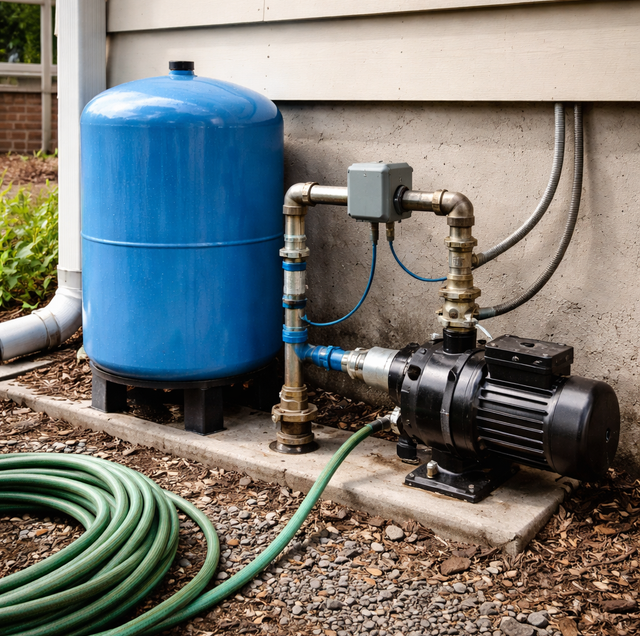
Quick Answer: A well pressure tank stores water compressed by a captive air charge. When you open a tap, the pressurized air pushes stored water to the fixture, so the pump stays off until the tank empties to a set point. This spares the pump from starting hundreds of extra times a day and keeps household water pressure steady between cycles.
That squat, dome-topped tank sitting next to your well pump does one quiet job that keeps the whole system alive. It holds a reserve of water pushed under air pressure, so when you open a faucet, water comes out of storage first instead of forcing the pump to fire up for every single draw. Understanding the air cushion inside it and the rest of the system suddenly makes sense.
The Air Cushion Is the Whole Idea
Water does not compress. Air does. That single fact is why a pressure tank exists.
Inside the tank, air is held under pressure on one side of a flexible barrier, and water sits on the other. As the pump pushes water in, the trapped air squeezes tighter, like a spring being loaded. When you open a tap, that compressed air is what shoves the water back out to your fixtures. The pump does not need to run for you to get a glass of water, a flushed toilet, or a two-minute hand wash. You are drawing from the stored reserve the air is holding under tension.
Without that cushion, the pump would have to switch on the instant any tap opened and off the instant it closed. On a busy morning that could mean the motor starting and stopping dozens of times in an hour. The air charge turns those constant tiny demands into a few controlled fill-and-empty cycles instead.
How a Bladder or Diaphragm Tank Works
Most modern residential systems use a bladder tank or a diaphragm tank. Both keep the air and water physically separated, which matters more than it sounds.
The two chambers: A bladder tank has a balloon-like rubber bladder inside the steel shell. Water fills the bladder as the pump runs; the air charge lives in the space around it, sealed inside the tank. A diaphragm tank works on the same principle but uses a fixed rubber membrane stretched across the middle, water below, air above. In either design, the air never touches the water.
Why separation matters: Older systems used a plain air-over-water tank with no barrier, and air slowly dissolved into the water and got carried off down the pipes. Those tanks became "waterlogged" fast and needed frequent recharging. A sealed bladder or diaphragm holds its air charge for years because the two never mix. When you see a small valve cap on top of the tank, that is the air-fill valve, the same style used on a car tire, and it feeds the air side only.
The Pressure Switch and Cut-In/Cut-Out
The tank stores the water, but a separate part decides when the pump turns on and off: the pressure switch. It watches the water pressure in the system and reacts to two set points.
The lower number is the cut-in pressure, where the switch tells the pump to start. The higher number is the cut-out pressure, where the switch shuts the pump off because the tank is full and pressurized. A very common factory setting is 40/60, meaning the pump kicks on at 40 psi and off at 60 psi. Some homes run 30/50 instead. The 20 psi gap between the two is deliberate, and it is what gives you a working reserve of water.
While water sits in the tank between those two points, your faucets stay somewhere in that 40-to-60 range. Pressure drifts down as you use water, and once it hits the cut-in point, the pump refills the tank back up to cut-out.
Setting the Air Charge Below Cut-In
Set the tank's air pre-charge about 2 psi below the pump's cut-in pressure. On a 40/60 system, that means roughly 38 psi of air in the tank when it is empty of water, which lets the tank deliver its full stored volume with no dead spot.
That 2 psi buffer is not arbitrary. If the air charge matched or exceeded the cut-in pressure, the air would push all the water out before the pump ever came on, and you would lose pressure at the tap in the gap. Set it a touch below cut-in and the tank delivers its full stored volume right down to the moment the pump restarts, with no dead spot. Get the pre-charge wrong, and even a healthy tank behaves like a failing one.
The air charge is checked with the pump powered off and the system pressure drained to zero, because any water pressure in the tank throws the reading off completely. More on that below.
Drawdown: The Usable Water Between Cycles
Drawdown is the amount of water you can actually pull from the tank before the pump has to run again. It is not the tank's total size. A 44-gallon tank does not give you 44 gallons of drawdown; it might give you 10 to 14, depending on the pressure settings and the air charge.
The reason is that the tank is never all water. Part of its volume is always occupied by the compressed air doing the pushing. The wider your cut-in to cut-out spread and the larger the tank, the more drawdown you get per cycle. A bigger drawdown means the pump runs less often and for longer stretches when it does run, which is exactly what a motor wants.
Think of the tank as a savings account the pump deposits into. You spend from the balance all day at the taps, and the pump only makes a deposit when the balance runs low. A bigger account means fewer, larger deposits and a lot less wear on the teller.
Signs of a Waterlogged or Failing Tank
When the air charge is lost, whether from a ruptured bladder or a leaked-out charge, the tank goes "waterlogged," meaning it fills almost entirely with water and has little or no air left to do its job. The symptoms are distinctive.
Rapid, machine-gun cycling: The clearest sign is the pump switching on and off in quick bursts, sometimes every few seconds, while a tap runs. With no air cushion, the tiny remaining pocket of water empties and refills almost instantly, so the pump chases it on and off. This short-cycling is hard on the motor, the switch contacts, and the pump's starting components.
Sputtering and pressure swings: Air spitting from the faucet, pressure that jumps from strong to weak mid-shower, and short bursts of water that die off quickly all point to a lost or unbalanced air charge. A failed bladder can also let a slug of air reach the taps.
A tank that feels wrong: Tap the side of the tank. The lower portion holding water sounds dull and solid; the upper air section rings hollow. A waterlogged tank sounds full and heavy all the way up. A tank that feels unusually heavy for its size is another tell.
How the Air Charge Is Checked
Checking the pre-charge is a specific sequence, and doing it out of order can give a false reading or risk injury from stored pressure.
A pressure tank holds real stored energy even when the pump is off, so this is not a job to improvise. Switch the pump off at the breaker and drain the system pressure to zero before taking any reading, because doing it out of order risks injury from stored pressure.
First, the pump is switched off at the breaker so it cannot restart mid-check. Then the system pressure is drained by opening the lowest faucet or the tank drain until water stops flowing and the gauge reads zero. Only with the water side fully depressurized does an accurate reading come off the air valve on top, taken with a standard tire pressure gauge. Air is added with a compressor or bicycle pump if the charge is low, or bled off if it somehow reads high, until it sits about 2 psi under cut-in.
A pressure tank holds real stored energy even when the pump is off, so this is not a job to improvise. Draining the water pressure first is what makes it safe. If the bladder has failed, air added through the valve will not hold, and the tank needs replacement rather than a recharge.
Why the Right-Sized Tank Saves the Pump
A pump motor's biggest enemy is starting. Each start draws a surge of current and heats the windings, and it is the on-off cycle, far more than continuous running, that wears a pump out. A tank sized correctly for the household's water use gives enough drawdown that the pump starts fewer times per day and runs longer each time.
An undersized tank, or one with a lost air charge, forces short-cycling that can shorten a pump's life dramatically. Matching tank size to the pump's flow rate and the home's demand is part of why a proper install outlasts a bargain one. The tank is cheap insurance for the most expensive part of the system.
Frequently Asked Questions
Once a year is a reasonable habit for a healthy tank, since a sealed bladder loses only a psi or two over that span. Check it sooner if you notice cycling changes. When testing, the reading should land within about 2 psi of its target; a tank that has dropped 10 psi or more in a year usually has a slow leak at the air valve or a weakening bladder.
Most standard bladder tanks are built to stand vertically, and mounting one on its side can let the bladder chafe against the shell and fail early. A few models are rated for horizontal use, but the tank tag or spec sheet has to state it. Orientation is not interchangeable across brands.
Water left in a tank that freezes can crack the steel shell or split the bladder, and a cracked shell is not repairable. Tanks in unheated well houses or garages need the space kept above freezing or the plumbing insulated and heat-taped. A tank that has frozen and thawed may look fine yet leak air past a hairline split in the bladder.
No. Pressure is set entirely by the cut-in and cut-out points on the pressure switch, not by tank size. A larger tank gives more drawdown and fewer pump starts, but your taps still run in the same psi range. To change actual pressure, you adjust or replace the switch, which is pump-side work.
The most common cause is an air pre-charge that was never set to match the pressure switch. A tank shipped with a generic 38 psi charge paired with a switch running 30/50 will cycle even though both parts are new. The charge has to be matched to the actual cut-in of your switch, about 2 psi under it, before the system settles down.
Only with a constant-pressure system that uses a variable-speed pump and controller to ramp output up and down instead of cycling on and off. A conventional single-speed pump without a tank would burn out fast from nonstop starting. Even many constant-pressure setups keep a small tank to smooth demand and give the controller a buffer.
Hearing the pump click on and off in quick bursts? Have the tank and air charge checked before the motor pays for it. Fussell Well Drilling serves Polk County and Central Florida. Call (863) 984-3144.
