
Waterlogged Pressure Tank: 5 Signs Your Pump Is Dying
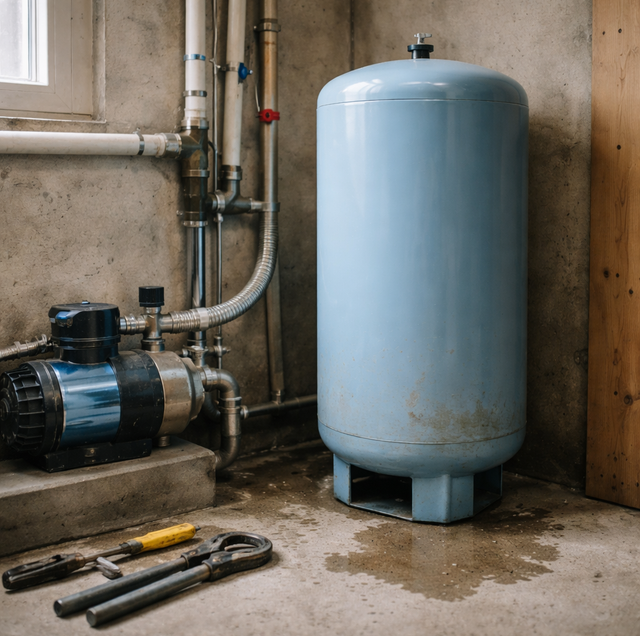
Quick Answer: A waterlogged pressure tank has lost its captive air charge, so water fills the space the air should occupy. With no air cushion to hold pressure between draws, the pump switches on and off rapidly (short-cycling), which wears it out fast. The fix is either recharging the air or replacing the tank, depending on why the air disappeared.
If the tank in your well room has started clicking on and off every few seconds, or the water at your faucet surges and sputters, the problem usually is not the pump itself. It is the pressure tank that sits beside it. When people describe a tank as "waterlogged," they mean it has lost the cushion of air it needs to do its job, and once that cushion is gone, the whole system starts working against itself.
How A Pressure Tank Is Supposed To Work
A well pump does not run every time you open a tap. If it did, it would burn out in a season. The pressure tank exists so the pump can push a batch of water, shut off, and rest while you draw from the stored supply.
Inside a healthy tank, there are two spaces kept apart. One holds water. The other holds a sealed pocket of air, the "precharge," that never mixes with the water. In most modern residential tanks, a flexible rubber bladder or diaphragm keeps the two apart. As the pump fills the tank, incoming water squeezes that air pocket smaller, and the compressed air pushes back. That push is what holds steady pressure at your faucets while the pump is off.
Air is springy in a way water is not. Squeeze a sealed balloon, and it gives, then shoves back. Water barely budges under the same force. That springiness is the entire reason the tank works, and it is exactly what a waterlogged tank has lost.
The air pocket also sets how much water you actually get per pump cycle, the "drawdown." A tank with a full, correct air charge might hand you several gallons between the pressure switch turning the pump on and off. Strip the air out and that drawdown collapses to almost nothing.
The Precharge And The Pump Cut-In: The air precharge is not a random number. It is matched to the pressure at which your pump switches on, the cut-in pressure. As a general rule, the precharge is set slightly below cut-in, so the tank still holds a small reserve of water at the exact moment the pump is about to kick on. Set it too high and the tank empties before cut-in, causing pressure to drop out; set it too low, and you lose drawdown. A pump technician measures your specific switch setting and charges the tank to suit it rather than guessing.
What "Waterlogged" Actually Means
A tank goes waterlogged when that air pocket shrinks or disappears, and water floods the space it used to occupy. Two things cause it.
The first is a slow leak of the air charge. Even a sealed tank can bleed air over years through the air valve, a fitting, or the small amount of air that dissolves into the water and gets carried off. As the pocket shrinks, the tank holds less and less pressure reserve.
The second is a ruptured bladder or diaphragm. When that rubber barrier splits, air and water are no longer separated. The air escapes or gets absorbed, and water simply fills the whole shell. Once the bladder tears, no amount of adding air will hold, because there is nothing left to keep the air where it belongs.
Either way, the result is the same. With little or no air to compress, the tank can no longer act as a spring. The instant you open a tap, pressure crashes, and the pump has to fire up immediately to make up for it.
The Symptoms You Can Notice
You do not need tools to spot a waterlogged tank. The system tells on itself.
Rapid Pump On-Off Cycling: This is the classic tell. Instead of the pump running for a stretch and then resting for several minutes, it snaps on and off every few seconds while you run water, sometimes even with a single faucet open. Tradespeople call this short-cycling. You may hear the pressure switch clicking in quick succession or the pump kicking repeatedly.
Sputtering or Surging Pressure: Because there is no air cushion to smooth delivery, pressure at the faucet pulses up and down in time with the pump. Water spits, surges, and drops. A shower that alternates between a strong stream and a trickle every few seconds is showing you the same problem from the other end of the pipe.
A Tank That Feels Full And Heavy: A properly charged tank is part air, so the upper portion feels lighter and sounds hollow. A waterlogged tank is solid water top to bottom. It feels noticeably heavier if you can rock it, and it may sweat or run with condensation on the outside because cold water now reaches all the way up the shell.
Water Hammer And Banging Pipes: With the cushioning air gone, the sudden stops and starts of water flow send shock waves through the plumbing. That produces the bang or thud in the pipes known as water hammer, often loudest when the pump cuts in or a valve closes.
Why Short-Cycling Destroys A Pump
Short-cycling is not just annoying. It is the mechanism that kills the pump, and understanding why explains the urgency.
Every time a well pump starts, its motor draws a large surge of current, far more than it does while running steadily. That inrush produces heat. A healthy system starts the pump only a handful of times an hour, so the motor sheds that heat between runs. A waterlogged tank can force dozens of starts in the same span. The motor never cools, the windings cook, and the start components take a beating they were never rated for.
The moving parts suffer too. Rapid stop-start cycling hammers the check valve, the pressure switch contacts, and the pump's bearings. A pressure switch that should last years can pit and fail in months under constant chattering. So a cheap loss of air in the tank cascades into an expensive pump or motor failure if it is ignored.
Checking The Tank Without Taking Risks
The well pump runs on electricity and the tank holds water under pressure, so leave anything involving wiring or opening the tank to a professional. Killing the power, draining the tank, and adjusting the charge are best left to a pro who can also judge whether the bladder is intact.
The Tap Test: With the pump running normally, rap your knuckles up the side of the tank from bottom to top. The lower, water-filled section returns a dull, solid thud. The upper, air-filled section rings back hollow. On a healthy tank, you can roughly hear where water ends, and air begins somewhere up the shell. On a waterlogged tank, the solid thud continues all the way to the top, because there is no air layer left to sound hollow.
The Air Valve: Most tanks have a valve on top that looks like the one on a car tire. Checking the air pressure there tells a technician whether the precharge is low. This reading is only meaningful when the system is depressurized with the pump breaker off and the water drained from the tank; otherwise, the water pressure skews the number. If you are comfortable pressing a tire gauge to a valve, you can note the reading and report it, but killing the power, draining the tank, and adjusting the charge work best when handed to a pro who can also judge whether the bladder is intact.
Recharge Or Replace
Whether the tank can be saved comes down to why the air left.
If the tank simply bled off its charge over time and the bladder is still sound, a technician can drain it, restore the air precharge to match your pump's cut-in setting, and put it back in service. That is a recharge, and a tank that holds the new charge is fine to keep.
If the bladder or diaphragm has ruptured, recharging is pointless. Air will not stay separated from water, so the tank cannot hold a cushion no matter how much you add. A tank that will not keep its charge after a proper recharge, or one that shows water at the air valve, has a failed bladder and needs replacement. Age matters here too. A tank near the end of its service life that has gone waterlogged is usually worth replacing outright rather than nursing along.
There is no single season for this. Air can bleed off just as easily during a mild spring as during a run of summer irrigation or a cold snap that has the pump working hard, so a waterlogged tank is a year-round diagnosis, not a weather event.
Frequently Asked Questions
A yearly check is a reasonable habit, ideally done at the same time as any other well service. Because tanks lose a little air gradually, catching a low precharge early lets a technician top it off before the bladder is stressed and before the pump starts short-cycling.
Yes. A pump that starts dozens of extra times an hour draws that heavy inrush current over and over, and inrush uses far more power than steady running. A pump laboring under a dead tank can push your power usage up noticeably until the tank is fixed.
There is. Older galvanized "air-over-water" tanks have no rubber barrier, so air and water touch directly, and the air slowly dissolves into the water, meaning those tanks waterlog more readily and some use a float or air-volume control to re-add air. Modern bladder and diaphragm tanks seal the air away, which is why they hold their charge far longer.
Sizing is driven by drawdown and how often you want the pump to cycle, not just by the physical dimensions. A common target is keeping the pump's run time at each cycle to at least a minute or so, which for many homes means a larger tank than expected. A tech sizes it against your pump's flow rate and switch settings rather than by tank volume alone.
Often, yes. A waterlogged tank produces surging, unstable pressure even when the pump is perfectly healthy, because there is no air cushion to hold a steady head between cycles. Ruling the tank in or out first can save you from replacing a pump that was never the problem.
It does, during a proper recharge or when re-pressurizing. The tank has to be depressurized and emptied of water before the air valve reading is accurate and before air can be added, since a tank full of water gives a false pressure and leaves no room to build the correct precharge. This is one reason the job is done with the power off and by someone who can refill and re-prime the system correctly.
Book a well system check before short-cycling burns out your pump — a quick tank test can save a costly motor. Fussell Well Drilling serves Polk County and Central Florida. Call (863) 984-3144.
