
Submersible Vs. Jet Pump: Which One Is Right for Your Well?
Quick Answer: A submersible pump sits underwater at the bottom of the well and pushes water upward, allowing it to handle far greater depths than a jet pump and keeping it essentially silent since the motor sits below ground. A jet pump sits above ground and pulls water up by suction, which caps its practical reach at shallower wells but puts the motor within easy reach for inspection and repair without disturbing the well itself. Submersible units generally run more efficiently at depth and last a comparable number of years to a well-kept jet pump, while a jet pump trades some reach and quiet for a motor you can service without pulling anything out of the ground.
A pump quote can name either style without explaining why one machine sits underwater at the bottom of a drop pipe while the other sits on a shelf in a utility closet. Both are doing the same job, moving groundwater into a home's plumbing at usable pressure, but the two designs get there through nearly opposite methods, and that difference shapes how deep each one can reach and what a repair actually involves. Picking between them comes down to matching a design to a well's depth, the water demand it has to meet, and how much access you want to a pump once it's installed.
How Each Pump Type Actually Moves Water
A submersible pump is a long, narrow cylinder built to hang below the water line on the end of a drop pipe, sometimes well over a hundred feet down. Inside, a sealed motor spins a stack of impellers, each stage adding a little more push, so the water arrives at the surface with enough force to reach the pressure tank and the fixtures beyond it. Because the whole assembly sits submerged, water surrounds the motor housing and carries heat away as it runs, and the design never has to fight gravity to get started.
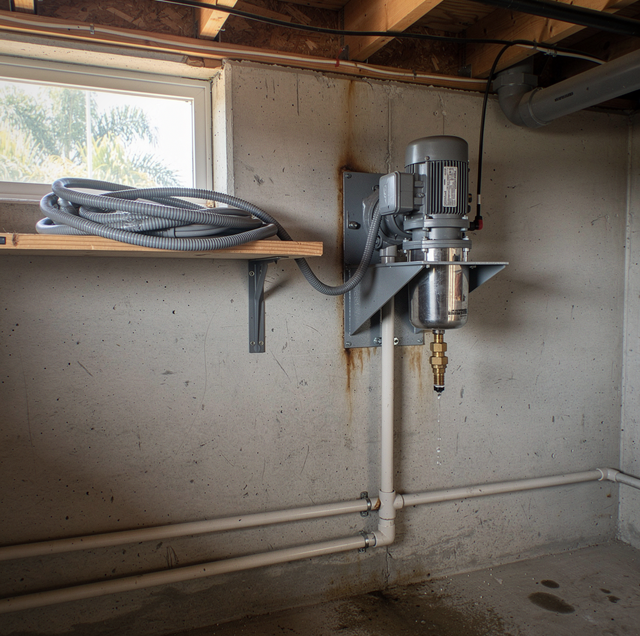
A jet pump works from the opposite direction. It sits above ground in a pump house, basement, or utility closet and draws water up through a suction line using a venturi assembly that creates a partial vacuum. Shallow-well jet pumps handle a single pipe and a limited vertical reach, while deep-well versions add a second line and an ejector assembly lowered into the well to boost suction capacity. Either version must maintain an unbroken column of water in the suction line to keep working; if air enters the line, the pump loses its prime and requires a manual restart before it draws water again.
Depth Suitability: What Each Pump Can Actually Reach
Suction has a hard physical ceiling. A pump pulling water from above can lift it only so far before the vacuum it creates can no longer hold a column of water together, and, in practical terms, that limits a shallow-well jet pump to wells with a water level roughly 25 feet or less below the pump. A deep-well jet pump, with its ejector assembly lowered into the well, extends its reach to 90 to well over 100 feet under favorable conditions, but performance and flow taper off as the water level drops farther from the surface.
A submersible pump doesn't face that ceiling, because it pushes rather than pulls. It can sit hundreds of feet down, limited mainly by the length of the drop pipe and power cable installed and by the pressure the motor and impeller stack generate, not by any suction limit. For a well with a deep static water level, or one where the pumping level drops during heavy use, a submersible is usually the only design that reaches the water reliably. A shallow well with a stable water table leaves either style workable, and the choice turns on the factors below.
Efficiency: Energy Use And Output Per Foot Of Lift
A submersible pump pushes water from below, which is inherently a more efficient way to move it than pulling it from above against a vacuum. Multistage impellers convert motor energy into lift with little loss, and because the motor runs submerged, none of its output goes toward fighting suction losses in a long vertical pipe. A jet pump has to overcome the physical inefficiency of suction lift itself, and a deep-well version loses additional energy through the extra plumbing and ejector assembly needed to reach depth, so its output per unit of power falls off more sharply as the well gets deeper.
At shallow depths, the gap narrows considerably, and a well-matched jet pump can run close to a submersible's efficiency for that same job. The gap widens with depth, which is one more reason depth tends to settle the choice before efficiency becomes the deciding factor.
Noise: What You'll Actually Hear Day To Day
A submersible pump runs out of earshot by design. It sits below ground, sealed inside the well casing and surrounded by water, so the motor's hum and vibration never reach the house. Aside from a faint hum sometimes audible right at the wellhead cap, most households never hear a submersible pump operate at all.
A jet pump is a different experience, because the motor lives inside the home's footprint, in a utility closet, basement, or attached pump house. Even a well-mounted unit produces a motor hum and a mechanical vibration that can carry through a floor or a shared wall, and that vibration is often more noticeable than the sound itself on a rigid mount without isolation pads. For a pump near a bedroom or other quiet space, that noise is worth weighing alongside depth and access.
Maintenance Access: What Happens When Something Needs A Look
This is where a jet pump has a clear edge. Because the entire pump sits above ground, a technician can inspect it, replace a worn seal or bearing, check the wiring, or troubleshoot a lost prime without disturbing anything below the surface. Minor issues often get caught early simply because the pump is visible and easy to reach.
A submersible pump is the opposite case. Any hands-on repair requires pulling the entire unit out of the well on its drop pipe, which requires specialized equipment and sufficient clearance above the wellhead to raise the full length safely. Even a simple seal replacement turns into a full pull-and-reset procedure. In exchange for that added labor, a submersible pump is shielded from the weather and temperature swings a jet pump in an unconditioned space has to tolerate, which tends to mean fewer things go wrong in the first place.
Typical Lifespan: How Long Each Style Usually Runs
Both designs fall within a broadly similar range, commonly cited as 8 to 15 years of service, though real-world results vary widely depending on water quality and how the system is used. What shortens each type differs. A submersible pump's life traces mainly to how often the motor cycles on and off and how much sediment or mineral grit the water carries past its impellers over the years. A jet pump's life traces more to priming reliability, exposure to temperature extremes in an unconditioned space, and mechanical wear on a motor that isn't shielded from vibration the way a submerged unit is. Neither style has a built-in lifespan advantage; a well-maintained example of either can outlast the average by years, while a neglected one can fail early.
Submersible Vs. Jet Pump At A Glance
| Feature | Submersible Pump | Jet Pump |
|---|---|---|
| Depth suitability | Effectively unlimited within drop-pipe and motor capacity; the standard choice for deep wells | Shallow-well version limited to roughly 25 feet of lift; deep-well version reaches further but loses output as depth increases |
| Efficiency | Higher output per unit of power, especially at depth, since it pushes rather than pulls | Comparable at shallow depth; drops off notably as well depth increases |
| Noise | Essentially silent from inside the home; motor sits below ground | Audible motor hum and vibration from wherever it's mounted above ground |
| Maintenance access | Requires pulling the pump from the well; specialized equipment needed for any repair | Fully accessible above ground; visual inspection and most repairs don't disturb the well |
| Typical lifespan | Roughly 8 to 15 years, driven mainly by cycling frequency and water quality | Roughly 8 to 15 years, driven mainly by priming reliability and exposure to the elements |
| Installation location | Submerged in the well casing at the bottom of the drop pipe | Above ground in a pump house, utility closet, basement, or similar space |
| Priming | Never loses prime; already submerged in water | Can lose prime if the suction line takes on air; needs to be manually reprimed |
Which Setup Fits Which Situation
Well depth and the pumping water level settle most of this decision before anything else does. A deep well, or one where heavy use pulls the water level well below the surface, generally calls for a submersible pump simply because a jet pump can't reach that far reliably. A shallow well with a stable water table leaves both options on the table, and from there the decision often turns on how much you value quiet operation and easy access.
A household with a bedroom or living space near where the pump would sit often leans toward a submersible for the sake of quiet, even on a well shallow enough for either style to work. A pump living in a detached outbuilding or a space nobody spends time in loses some of that advantage, and easy access for routine checks might matter more. Replacing an existing pump usually keeps the same style the well was built for, since the casing, drop pipe, and wiring are already set up around one design, and switching types midstream often means more rework than the swap is worth. A well serving heavy irrigation demand, where flow and depth both matter, tends to favor a properly sized submersible for the output it sustains without losing efficiency at depth.
Frequently Asked Questions
Sometimes, but it depends on how the well was built. A well with a wide enough casing and a straight bore can often accept a submersible pump even if it started with a jet pump setup, though the plumbing, wiring, and pressure tank connections usually need reworking to match. Converting a deep well from submersible to jet pump is far less common, since a jet pump's suction limit requires the water level to be within its reach, which a well drilled for a submersible often doesn't provide.
Depth is the biggest factor, but not the only one. A shallow well can accept either style, so noise tolerance, how much easy access you want, and how the well was originally set up all come into the decision once depth stops being the limiting factor. A pumping water level that drops significantly during heavy use needs sizing around that lower level, not just the well's resting depth, which sometimes pushes a borderline case toward a submersible.
Neither design resists sediment better; both wear the same way when abrasive grit passes across impellers and seals over years of use. What matters more is the well's own condition, since a worn or corroded well screen lets more sediment through regardless of which pump sits behind it. A wellhead screen or sediment separator installed ahead of either type does more to protect it than the pump's design alone.
A jet pump that loses prime stops drawing water even though the motor keeps running, usually because air entered the suction line through a loose fitting, a cracked pipe, or a drop in water level that briefly exposed the intake. It needs to be manually refilled and reprimed before it draws water again. A submersible pump doesn't have this failure mode, since it stays submerged and never has to establish a vacuum to start moving water.
A submersible pump generally converts more of its energy into lift with less waste, particularly at greater depths, so it tends to draw less power for the same output. A jet pump serving a shallow well narrows that gap considerably, and at shallow depth the difference is often small enough that noise and access end up mattering more to the decision.
Yes. A submersible works fine in a shallow well and isn't limited to deep applications; it simply sits lower in the casing than it would in a well with a deeper water table. Many homeowners choose a submersible pump for a shallow well for its quiet operation and protection from weather and temperature fluctuations, even though a jet pump could technically do the job.
Get a pump-type recommendation before you replace anything — a technician can match the pump design to your well's depth and yield, rather than guessing. Fussell Well Drilling serves Polk County and Central Florida. Call (863) 984-3144.
